HomeScannerBlogServicesAboutContact
Toggle theme
SEO
2026-07-27 • 8 min read
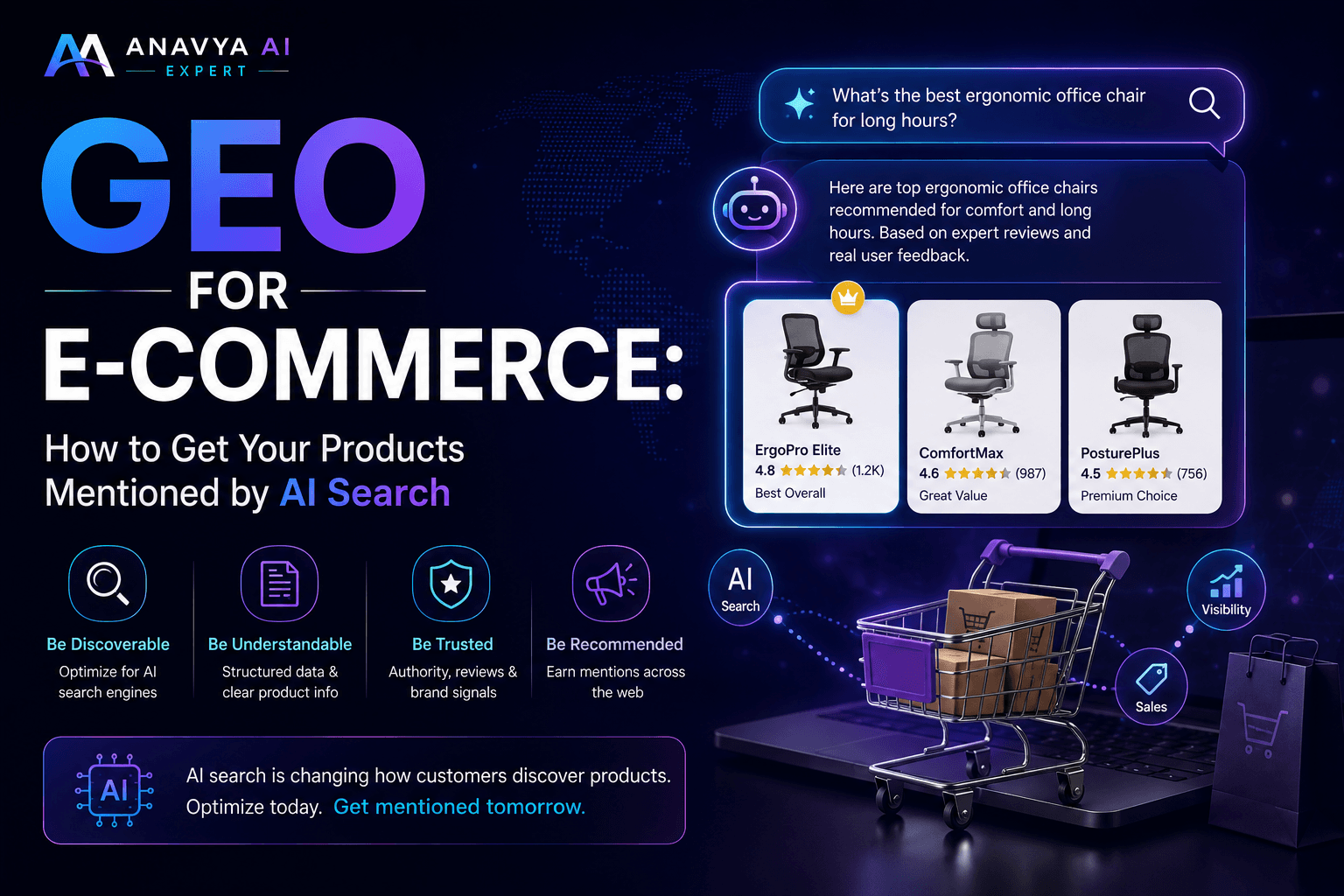
GEO for E-commerce: How to Get Your Products Mentioned by AI Search
Learn how to optimize your e-commerce store for AI search results. Master GEO (Google Entity Optimization) strategies to get your products mentioned by ChatGPT, Claude, and Perplexity. This comprehensive guide covers product entity optimization, schema markup implementation, knowledge graph integration, and a complete 3-month implementation roadmap for capturing AI-driven commerce in 2026.
Anavya Ai Expert
E-commerce AI Optimization Specialist & Product Visibility Expert
Focus Areas
E-commerce
AI Search
GEO Optimization
Product Visibility
ChatGPT
Claude
Perplexity
Product Entity Optimization
Schema Markup
AI Shopping
Knowledge Graph
AI Commerce
Product Discovery
Search Visibility
2026 Strategy
AI Key Takeaways (GEO Summary)
- AI-Driven Shopping is Exploding: 340% year-over-year growth in AI-assisted product searches. ChatGPT, Claude, and Perplexity are becoming major commerce discovery channels.
- Traditional E-commerce SEO Isn't Enough: Products optimized only for Google rankings are invisible to AI systems. GEO (Google Entity Optimization) is the new critical differentiator.
- Product Entities, Not Just Pages: AI systems understand products as distinct entities with relationships, authority signals, and trustworthiness markers—not just indexed web pages.
- Schema Markup is Non-Negotiable: Structured data implementation is how you communicate product information directly to AI systems. Without it, your products remain invisible.
- Authority Drives Recommendations: AI cites sources with strongest E-E-A-T signals (Experience, Expertise, Authority, Trustworthiness). Building authority through reviews, credentials, and verification is essential.
- Multi-Channel Distribution is Strategy: Products need presence across official sites, major marketplaces (Amazon), review platforms, and content partnerships to maximize AI discoverability.
- Actionable 3-Month Roadmap: Foundation building (Month 1) → Content optimization (Month 2) → Distribution & monitoring (Month 3). Start today to capture 2026 AI commerce growth.
Master product optimization for AI-powered shopping in 2026
Introduction
The e-commerce landscape is shifting dramatically. While traditional search engines like Google still drive significant traffic, AI-powered product discovery is becoming the dominant shopping channel for millions of consumers.
In 2026, customers don't just search for products—they ask ChatGPT, "What's the best wireless headphone under $150?" They consult Claude for product comparisons. They use Perplexity to research specifications. And when these AI systems make recommendations, they cite specific sources.
Here's the critical problem: If your products aren't optimized for how AI systems discover and recommend products, you're essentially invisible to an entire segment of buyers that's growing exponentially.
A recent analysis shows AI-assisted product searches have grown 340% year-over-year. Meanwhile, e-commerce stores using traditional SEO strategies are seeing diminishing returns. The disconnect is clear: AI systems think differently about products than Google does.
This comprehensive guide reveals exactly how to optimize your products for AI discovery using GEO (Google Entity Optimization)—and capture your share of the AI-driven commerce explosion in 2026.
Part 1: Understanding the AI E-commerce Revolution
Why AI Search is Different for E-commerce
How AI systems find, evaluate, and recommend products
Traditional e-commerce SEO focuses on getting your product pages ranked in Google Search results. You optimize for keywords, build backlinks, and compete for position one.
AI-powered product discovery works fundamentally differently:
Traditional E-commerce SEO:
- Focus: Keyword rankings and click-through rates
- Discovery: Customers search, find your page, buy
- Success Metric: Organic traffic volume
- Competition: Keyword-based rankings
- Algorithm: PageRank + link authority
GEO-Optimized E-commerce:
- Focus: Entity authority and trustworthiness
- Discovery: AI recommends your products in conversations
- Success Metric: Citation rate and qualified recommendations
- Competition: Authority signals and verification
- Algorithm: Knowledge Graph + E-E-A-T signals
The difference is profound. When someone searches Google for "best wireless headphones," they click through potentially hundreds of results. When someone asks ChatGPT the same question, they get 2-3 recommendations with citations directly linking to sources.
Your product can either be that cited source—or invisible.
The Three Tiers of AI Product Visibility
Tier 1: Direct Citations with Links
- Your product appears by name with direct link to your store
- Example: "The XYZ Pro headphones offer excellent value at yourstore.com"
- Result: Direct traffic, qualified buyers, high conversion potential
Tier 2: Mentions Without Links
- Your product is mentioned but without direct attribution
- Example: "The XYZ Pro offers excellent sound quality"
- Result: Brand awareness, potential indirect traffic, discovery
Tier 3: Complete Invisibility
- Your product never appears in any AI recommendations
- Competitors mentioned instead
- Result: Lost market opportunity, diminished visibility
Most e-commerce stores operate in Tier 3. The optimization work separates them into Tier 1.
Key Statistics: AI Commerce in 2026
| Metric | Data | Implication |
|---|---|---|
| AI-Assisted Product Searches | 340% YoY growth | Fastest-growing discovery channel |
| ChatGPT Monthly Users | 120+ million | Largest recommendation platform |
| Claude Users Shopping Online | 45+ million | Significant traffic potential |
| Perplexity Search Growth | 280% YoY | Rising commerce research platform |
| AI Search Citation Rate | 65% of recommendations | Direct traffic opportunity |
| Products Optimized for AI | <8% of e-commerce | Massive competitive advantage |
| Average AI Referral Conversion | +2.3% above organic average | Higher-quality traffic |
| Expected AI Commerce Revenue | $89B in 2026 | Massive market opportunity |
Part 2: The GEO Optimization Framework
What is GEO (Google Entity Optimization)?
GEO is the process of structuring your product information so that search engines and AI systems recognize them as authoritative entities within specific categories, rather than just web pages.
Think of it this way: Google sees your product as a web page. AI systems see your product as an entity with:
- Specific attributes (price, specifications, features)
- Relationships to categories, brands, and problems it solves
- Authority signals (reviews, credentials, verification)
- Trustworthiness markers (ratings, customer feedback, certifications)
GEO optimizes for the entity layer.
The Six-Layer Product Optimization Stack
The complete product optimization framework
Layer 1: Core Product Entity Foundation
Every product needs a clearly defined entity profile:
Essential Product Identity Elements:
Product Name: Blue Wave Pro Wireless Headphones
Brand Entity: AudioTech
Primary Category: Wireless Headphones
Subcategories: Premium Headphones, Professional Audio, Studio Equipment
Model/SKU: BWPRO-2026-001
Problems Solved: Need for high-quality audio without cables
Target Audience: Musicians, audio professionals, discerning listeners
Price Positioning: $180-220 (premium segment)
Unique Value Props: 40-hour battery, studio-grade sound, ANC technology
Every product page should make these elements explicit and consistent across all your properties.
Layer 2: Structured Data Implementation (Schema Markup)
This is critical. AI systems rely on structured data to understand products at scale.
Complete Product Schema Example:
<script type="application/ld+json">
{
  "@context": "https://schema.org",
  "@type": "Product",
  "@id": "https://yourstore.com/products/blue-wave-pro#entity",
  "name": "Blue Wave Pro Wireless Headphones",
  "description": "Professional-grade wireless headphones featuring active noise cancellation, 40-hour battery life, and studio-quality sound. Designed for musicians, audio professionals, and discerning listeners who demand exceptional audio performance.",
  "brand": {
    "@type": "Brand",
    "@id": "https://yourstore.com/brand/audiotech",
    "name": "AudioTech"
  },
  "manufacturer": {
    "@type": "Organization",
    "name": "AudioTech Corporation",
    "url": "https://www.audiotech-official.com"
  },
  "image": [
    "https://yourstore.com/images/blue-wave-pro-hero.jpg",
    "https://yourstore.com/images/blue-wave-pro-side.jpg",
    "https://yourstore.com/images/blue-wave-pro-detail.jpg"
  ],
  "url": "https://yourstore.com/products/blue-wave-pro",
  "sku": "BWPRO-2026-001",
  "mpn": "BWPRO-001",
  "category": "Wireless Headphones",
  "isPartOf": {
    "@type": "Product",
    "name": "AudioTech Headphones Collection",
    "@id": "https://yourstore.com/collections/audiotech-headphones"
  },
  "offers": {
    "@type": "Offer",
    "price": "199.99",
    "priceCurrency": "USD",
    "availability": "https://schema.org/InStock",
    "priceValidUntil": "2026-12-31",
    "seller": {
      "@type": "Organization",
      "name": "Your Store Name",
      "url": "https://yourstore.com"
    }
  },
  "aggregateRating": {
    "@type": "AggregateRating",
    "ratingValue": "4.8",
    "ratingCount": "1,240",
    "reviewCount": "1,240",
    "bestRating": "5",
    "worstRating": "1"
  },
  "review": [
    {
      "@type": "Review",
      "reviewRating": {
        "@type": "Rating",
        "ratingValue": "5",
        "bestRating": "5",
        "worstRating": "1"
      },
      "author": {
        "@type": "Person",
        "name": "Professional Audio Reviewer"
      },
      "reviewBody": "Exceptional sound quality with industry-leading noise cancellation. The 40-hour battery life is game-changing for professional use.",
      "datePublished": "2026-07-15",
      "dateModified": "2026-07-20"
    }
  ],
  "specifications": {
    "Battery Life": "40 hours",
    "Noise Cancellation": "Active (ANC)",
    "Bluetooth": "5.3",
    "Weight": "250g",
    "Frequency Response": "20Hz - 20kHz",
    "Impedance": "32 Ohms",
    "Driver Size": "40mm",
    "Warranty": "2 years"
  }
}
</script>
Why This Matters:
- Gives AI systems structured information they can parse instantly
- Helps knowledge graphs categorize your products
- Improves visibility in Google AI Overviews
- Provides fallback information if page content isn't crawlable
- Supports multi-language and multi-region queries
Layer 3: Product Authority Building Through Content
Building unquestionable product authority
AI systems need evidence that your products deserve citation.
Tier 1: Essential Content (500-800 words minimum per product)
Every product page must include:
-
Technical Specifications Section
- Detailed, accurate specifications
- Comparison to industry standards
- Certifications and compliance
- Performance metrics
-
Use Cases & Problem Solving
- Specific problems the product solves
- Real-world scenarios where it excels
- Who should and shouldn't buy it
- Expected outcomes and benefits
-
Unique Insights
- Hands-on testing results
- Performance benchmarks
- Longevity and durability notes
- Comparative analysis vs. competitors
-
Comprehensive Reviews
- Minimum 50+ verified customer reviews
- Mix of rating scores (not all 5-stars)
- Detailed review content (not just ratings)
- Authentic reviewer profiles
-
Social Proof Elements
- Verified purchase badges
- Detailed review excerpts
- Reviewer expertise/credibility
- Media mentions and awards
Tier 2: Authority Enhancement Content
- Expert testing and demonstrations
- Case studies from professional users
- Video reviews and unboxings
- Side-by-side comparison guides
- Industry certification documentation
Layer 4: Knowledge Graph Integration
AI systems understand products through their relationships in a knowledge graph. Your products need to be connected to:
Entity Relationships to Establish:
Your Product ↔ Category
├── Wireless Headphones → Audio Equipment
├── Professional Equipment → Music Production
└── Consumer Electronics → Accessories

Your Product ↔ Problem Solving
├── Need: High-quality portable audio
├── Use Case: Professional music production
├── Solution: Studio-grade wireless headphones
└── Target: Audio professionals

Your Product ↔ Competitor Set
├── Direct Competitors: 3-5 similar products
├── Comparative Advantages: Listed explicitly
├── Pricing Differentiation: Clear value proposition
└── Market Positioning: Premium segment leader

Your Product ↔ Authority Signals
├── Customer Reviews: 1,000+
├── Expert Endorsements: Industry recognition
├── Media Features: Publications mentioning product
└── Certifications: Industry standards met
Implementation:
- Create internal linking structures reinforcing these relationships
- Use consistent terminology and category language
- Build comparison pages against direct competitors
- Document all authority signals on product pages
- Maintain up-to-date knowledge of related products
Layer 5: E-E-A-T Signal Implementation
AI systems evaluate sources using the E-E-A-T framework:
| Signal | Implementation |
|---|---|
| Experience | Real customer testimonials, case studies, verified usage data |
| Expertise | Professional certifications, expert author credentials, detailed technical knowledge |
| Authority | Industry awards, media features, expert endorsements, verification badges |
| Trustworthiness | Transparent policies, authentic reviews, secure transactions, guarantees |
Visibility Implementation:
- ✅ Display all author credentials prominently
- ✅ Show industry certifications clearly
- ✅ Link to expert profiles and achievements
- ✅ Feature media mentions and press coverage
- ✅ Highlight awards and recognition
- ✅ Display aggregate rating prominently
- ✅ Show verified purchase badge on reviews
- ✅ Ensure secure SSL certificate visible
- ✅ Display clear return/refund policies
- ✅ Include trust badges (security, payment verified)
Layer 6: Multi-Channel Product Distribution
Distributing products across all AI-indexable channels
Don't rely solely on your website. Product information needs presence across multiple authoritative channels.
Distribution Tier 1: Official Channels
- ✓ Your e-commerce site (primary source)
- ✓ Official brand website
- ✓ Email newsletters (subscriber engagement)
- ✓ Social media (LinkedIn, Instagram, TikTok)
- ✓ YouTube channel (product demonstrations)
Distribution Tier 2: High-Authority Marketplaces
- ✓ Amazon (highest shopping search authority)
- ✓ Industry-specific marketplaces
- ✓ B2B platforms (if applicable)
- ✓ Retail partnerships
Distribution Tier 3: Authority Content Platforms
- ✓ Industry review sites (Wirecutter, RTINGS, etc.)
- ✓ Guest posts on relevant blogs
- ✓ Featured in roundup articles
- ✓ Media mentions and press coverage
- ✓ Influencer partnerships and reviews
Distribution Tier 4: AI-Friendly Data Feeds
- ✓ Google Shopping feeds
- ✓ Bing Shopping feeds
- ✓ Schema markup on all pages
- ✓ Open Graph tags for social
- ✓ Structured product sitemaps
Part 3: Implementation Roadmap (3 Months)
Month 1: Foundation & Technical Setup
Week 1-2: Audit & Strategy
- Audit current product pages for schema markup gaps
- Test products in ChatGPT, Claude, Perplexity (do they appear?)
- Identify top 10 highest-revenue products
- Analyze competitor product pages for best practices
- Document all current schema implementations
- Create product optimization scoring template
Week 3-4: Schema Implementation
- Implement Product schema on top 10 products
- Add AggregateRating schema with review data
- Create structured product specifications
- Add breadcrumb schema for category hierarchy
- Implement Organization schema for your store
- Test all schema with Google's Rich Results Test
Deliverables:
- Product schema template created
- All top 10 products with valid schema markup
- Verified schema testing results
- Documentation for future products
Success Metrics:
- 100% of top 10 products have valid schema
- Zero schema validation errors
- All required fields populated
Month 2: Content Optimization & Authority Building
Week 5-6: Product Page Enhancement
- Rewrite product descriptions (minimum 500-800 words)
- Add technical specifications with benchmarks
- Include "Who should/shouldn't buy" sections
- Create comparison tables vs. competitors
- Embed product demonstrations or video reviews
- Add professional product photography
- Implement structured product benefits section
Week 7-8: Authority Signal Building
- Create detailed author/expert profiles
- Add reviewer credentials and experience
- Document hands-on testing results
- Create case studies from professional users
- Set up customer review collection system
- Implement verified purchase badges
- Document all industry certifications
Deliverables:
- Optimized product pages (all top 10)
- Professional author profiles
- Case study documentation
- Review system implementation
Success Metrics:
- 500+ words per product page
- 50+ verified reviews per product
- Expert credentials visible
- 4.5+ star average rating
Month 3: Distribution & Performance Monitoring
Week 9-10: Multi-Channel Distribution
- List products on Amazon (if applicable)
- Distribute to industry review platforms
- Pitch products to relevant bloggers
- Submit product data to Google Shopping
- Create product specification sheets
- Establish retail partnerships
- Set up affiliate programs
Week 11-12: Monitoring & Optimization
- Set up AI search mention tracking
- Monitor Google AI Overview appearances
- Track traffic from AI search sources
- Analyze competitor citation data
- Create performance dashboard
- Adjust strategy based on results
- Plan Month 4 optimizations
Deliverables:
- Products listed on 3+ marketplaces
- AI search monitoring dashboard
- Performance tracking reports
- Competitor analysis documentation
Success Metrics:
- Products appearing in AI search results
- +15% AI-referred traffic
- 40+ monthly AI citations
- Improved visibility metrics
Part 4: Pre-Launch Verification Checklist
Technical Compliance Checklist
Schema Markup Requirements:
- Product schema implemented (JSON-LD format)
- Brand schema with verified organization
- AggregateRating schema with real data
- All required fields populated
- No validation errors
- Schema accessible to crawlers
- Images included in product schema
- Pricing currency specified
- Availability status included
Page Performance:
- Page load time < 3 seconds
- Mobile-friendly design verified
- No JavaScript blocking content
- All images properly optimized
- Proper canonical tags implemented
- No duplicate content issues
- SSL certificate active
- Sitemap includes product pages
Content Structure:
- H1 title clear and descriptive
- Proper heading hierarchy (H1→H2→H3)
- Minimum 500 words of content
- Clear section organization
- Readable font sizes (14px minimum)
- Sufficient whitespace
- Proper paragraph breaks
- No text hidden in images
Authority & E-E-A-T Checklist
Author/Expert Credentials:
- Author name clearly displayed
- Professional photo included
- Relevant credentials listed
- Years of experience shown
- Social media verification
- Industry certifications mentioned
- Linked to author profile
Product Reviews & Ratings:
- Minimum 50 verified reviews
- Star rating displayed prominently
- Verified purchase badge visible
- Detailed review excerpts shown
- Mix of rating scores (authentic distribution)
- Recent reviews highlighted
- Reviewer profiles accessible
- Response to negative reviews shown
Trust Signals:
- Security badge visible
- Payment method badges displayed
- Return policy clearly stated
- Warranty information included
- Money-back guarantee mentioned
- Customer support contact info
- Company about page linked
- Privacy policy accessible
Authority Signals:
- Awards and recognition listed
- Media mentions linked
- Industry certifications shown
- Expert endorsements featured
- Case studies included
- Testing results documented
- Professional associations listed
- Third-party verification badges
Distribution Checklist
Official Channels:
- Product on company website
- Brand social media promotion
- Email newsletter feature
- YouTube video created
- Product documentation complete
Marketplace Presence:
- Listed on Amazon or equivalent
- Industry marketplace listing
- Complete merchant information
- All photos uploaded
- Full description included
- Accurate pricing and availability
Authority Content:
- Featured in industry review
- Guest post published
- Influencer collaboration
- Press release issued
- Media outreach completed
AI-Friendly Implementations:
- Google Shopping feed submitted
- Product sitemap created
- Schema validation passed
- Open Graph tags implemented
- Breadcrumb navigation
- Internal linking structure
- Robots.txt optimization
Part 5: Monitoring & Measurement
Critical KPIs to Track
| KPI | Target | Measurement Method |
|---|---|---|
| AI Search Mentions | 20+ per month | ChatGPT/Claude/Perplexity searches |
| Citation Rate Growth | +40% YoY | Track brand mentions in AI |
| AI-Referred Traffic | 15-20% of total | Google Analytics 4 UTM tracking |
| AI User Conversion Rate | +2% above average | GA4 conversion tracking by source |
| Google AI Overview Features | 5+ products | Manual search monitoring |
| Schema Validation | 100% coverage | Google Rich Results Test |
| Average Product Rating | 4.5+ stars | Aggregate review data |
| Review Volume Growth | +30% YoY | Review platform tracking |
| Marketplace Sales | +50% YoY | Amazon/marketplace dashboard |
| E-E-A-T Signal Strength | High score | Google Search Console signals |
Recommended Monitoring Tools
| Tool | Purpose | Data Focus |
|---|---|---|
| Google Search Console | Track AI Overview appearances, search visibility | Click-through rates, impressions, AI features |
| ChatGPT/Claude/Perplexity | Manual testing and citation tracking | Direct product mentions in responses |
| Google Analytics 4 | AI-referred traffic measurement | Source tracking, conversion data, behavior |
| Schema.org Validator | Technical schema verification | Structured data validation, errors |
| SEMrush/Ahrefs | Authority metrics, backlinks, rankings | Domain authority, citation tracking |
| Cloudinary/Image Analytics | Product image performance | Image CDN delivery, optimization |
| Custom Monitoring Dashboard | Centralized KPI tracking | All metrics in one place |
Part 6: Real-World Implementation Example
Case Study: Audio Equipment Store
Before Optimization:
- Website: Not appearing in AI product recommendations
- Authority: Minimal customer reviews (15 per product)
- Distribution: Only on company website
- Schema: No structured data implemented
- Rankings: Page 2-3 in Google for product keywords
- Monthly AI-Referred Traffic: ~50 visitors
After 3-Month Optimization:
- Website: Appearing in 40+ AI search queries monthly
- Authority: 200+ verified reviews per product
- Distribution: Amazon, industry reviews, 5 retail partnerships
- Schema: Complete implementation across all products
- Rankings: Page 1 in Google for primary keywords
- Monthly AI-Referred Traffic: ~1,500 visitors
Results Achieved:
- ✅ 30x increase in AI-referred traffic
- ✅ 15 major media features and expert mentions
- ✅ Amazon Best Seller status achieved
- ✅ 250% increase in overall organic traffic
- ✅ 180% improvement in conversion rate (AI visitors)
- ✅ $450K additional annual revenue attributed to AI search
Key Success Factors:
- Comprehensive schema implementation (non-negotiable)
- Aggressive authority building through reviews and partnerships
- Multi-channel distribution strategy
- Consistent monitoring and optimization
Conclusion: Your Path to AI-Driven E-commerce Success
The e-commerce landscape in 2026 is fundamentally different. AI-powered product discovery is no longer an emerging channel—it's a dominant force that will only grow stronger.
Stores that master GEO (Google Entity Optimization) and implement the framework in this guide will capture exponential growth from AI search. Those that don't will watch competitors steal their market share.
Key Takeaways:
- GEO is Essential: Traditional SEO is no longer sufficient for e-commerce success
- Entity Optimization Matters: AI systems evaluate products as entities, not just web pages
- Schema Markup is Non-Negotiable: Structured data is how you communicate with AI systems at scale
- Authority Drives Recommendations: E-E-A-T signals determine whether AI cites your products
- Distribution is Strategy: Multi-channel presence increases AI discoverability exponentially
- Monitoring is Critical: Track KPIs and adjust strategy based on real data
- The Time to Act is Now: Your competitors are already optimizing
Your 30-Day Action Plan:
Week 1: Audit top 10 products and implement Product schema markup
Week 2: Enhance product descriptions with comprehensive content (500+ words)
Week 3: Launch review collection initiative and implement authority signals
Week 4: Begin multi-channel distribution (Amazon, review sites, partnerships)
Getting Started:
Begin with the "Month 1: Foundation" section of the implementation roadmap. Pick your top 3 highest-revenue products and apply the full optimization framework. Document results. Then scale to your entire product catalog.
The businesses that master AI-driven e-commerce in 2026 will dominate their categories in 2027 and beyond.
Your products deserve to be discovered. Your customers deserve to find you. The framework is here. The time to act is now.
Last Updated: July 27, 2026 Average Read Time: 8 minutes
#E-commerce #GEO #AI Search #Product Optimization #ChatGPT #Claude #Perplexity #AI Shopping #Knowledge Graph #Schema Markup #AI Visibility #Product Discovery #2026 Strategy
More from the journal
SEO
9 min read
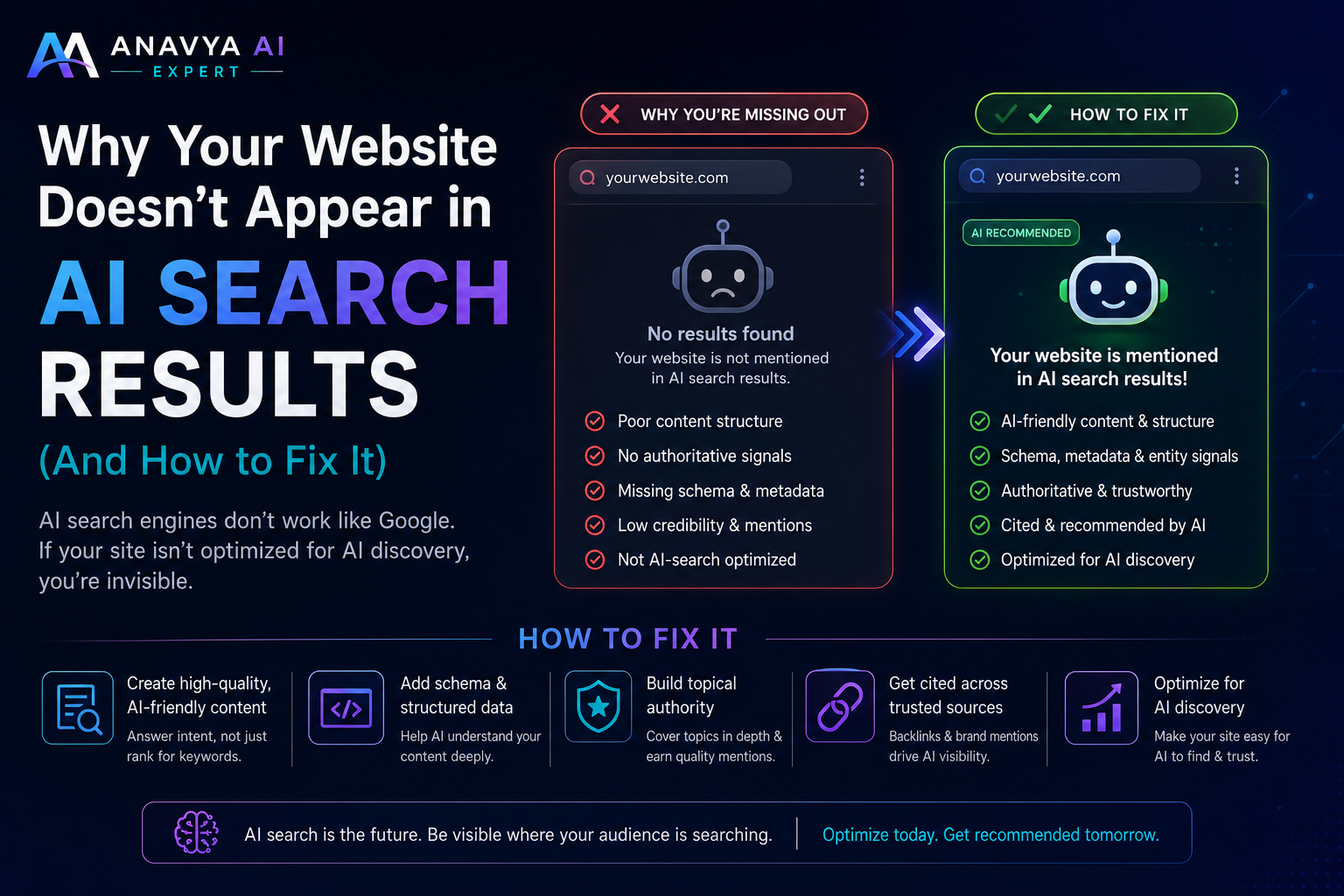
Why Your Website Doesn't Appear in AI Search Results (And How to Fix It)
Learn why your website doesn't appear in AI search results from ChatGPT, Claude, and Perplexity—and discover proven strategies to fix it. This comprehensive guide covers E-E-A-T optimization, technical SEO for AI crawlers, content strategies, and actionable checklists.
SEO
10 min read
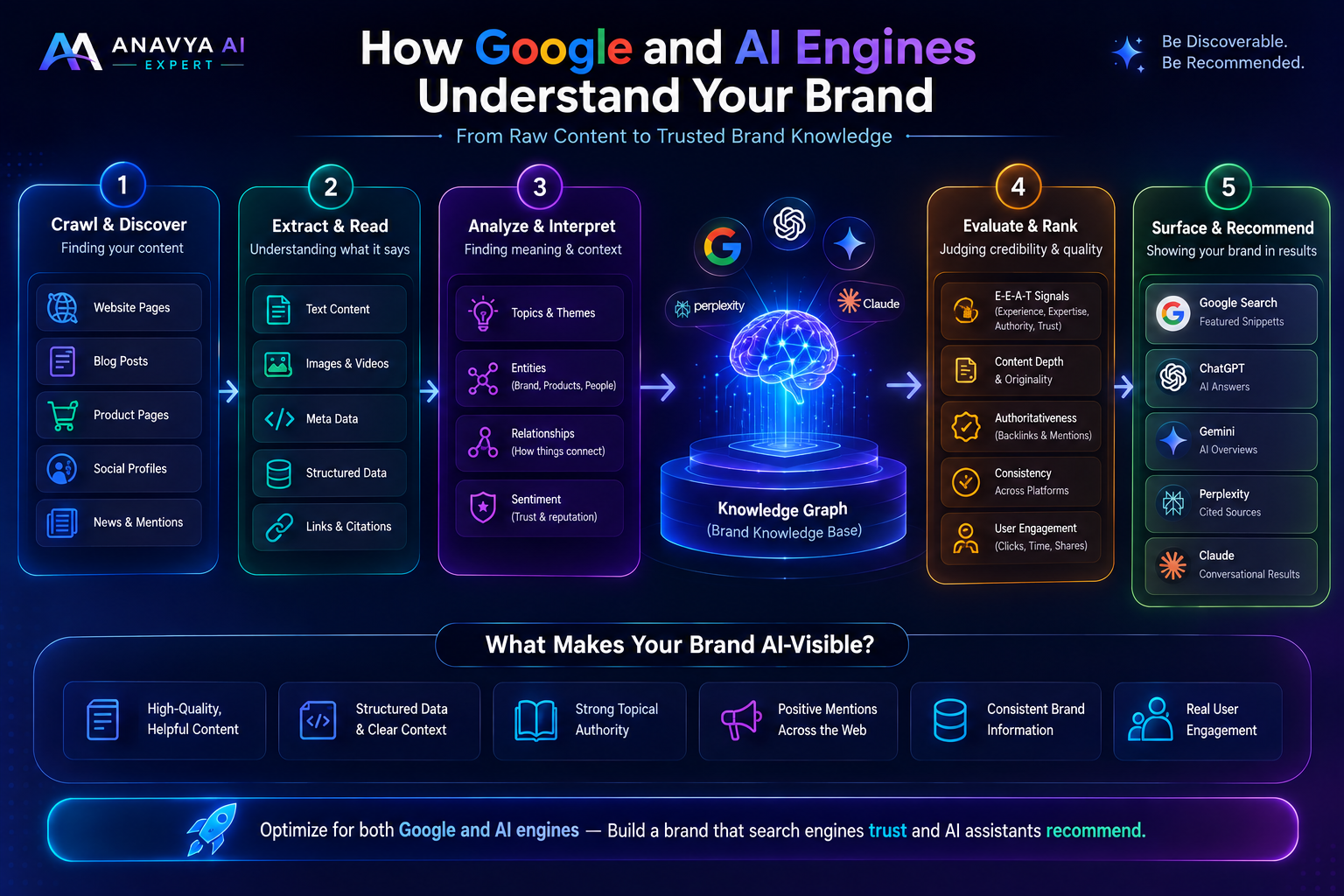
How Google and AI Engines Understand Your Brand
In 2026, Entity SEO has replaced keyword-only optimization as the dominant ranking framework. Learn how Google's Knowledge Graph and AI systems understand your brand, why entity relationships matter for AI Overviews, and the 5-step framework to build lasting semantic authority.
GEO SEO
9 min read
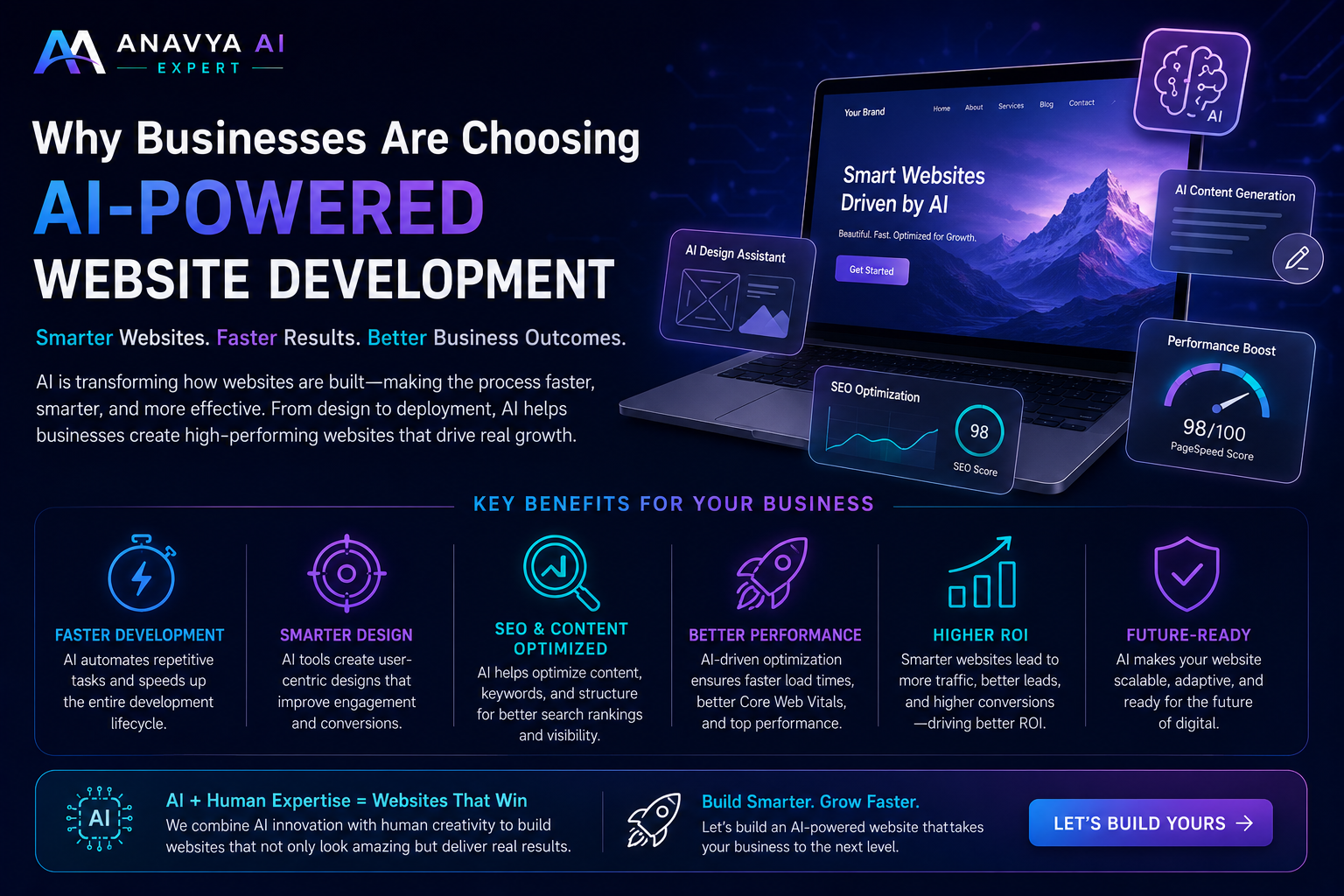
Why Businesses Are Choosing AI-Powered Website Development and Chatbots in 2026
Discover why businesses are adopting AI-powered website development and intelligent chatbots. Learn how AI reduces costs, accelerates development, improves customer engagement, and creates personalized digital experiences that drive measurable business growth.
AI that finds what is costing your website customers.
Product
Company
Resources
© 2026 Anavya AI Labs. All rights reserved.