How to Run a Competitor Scan for SEO, GEO, and AI Search Visibility
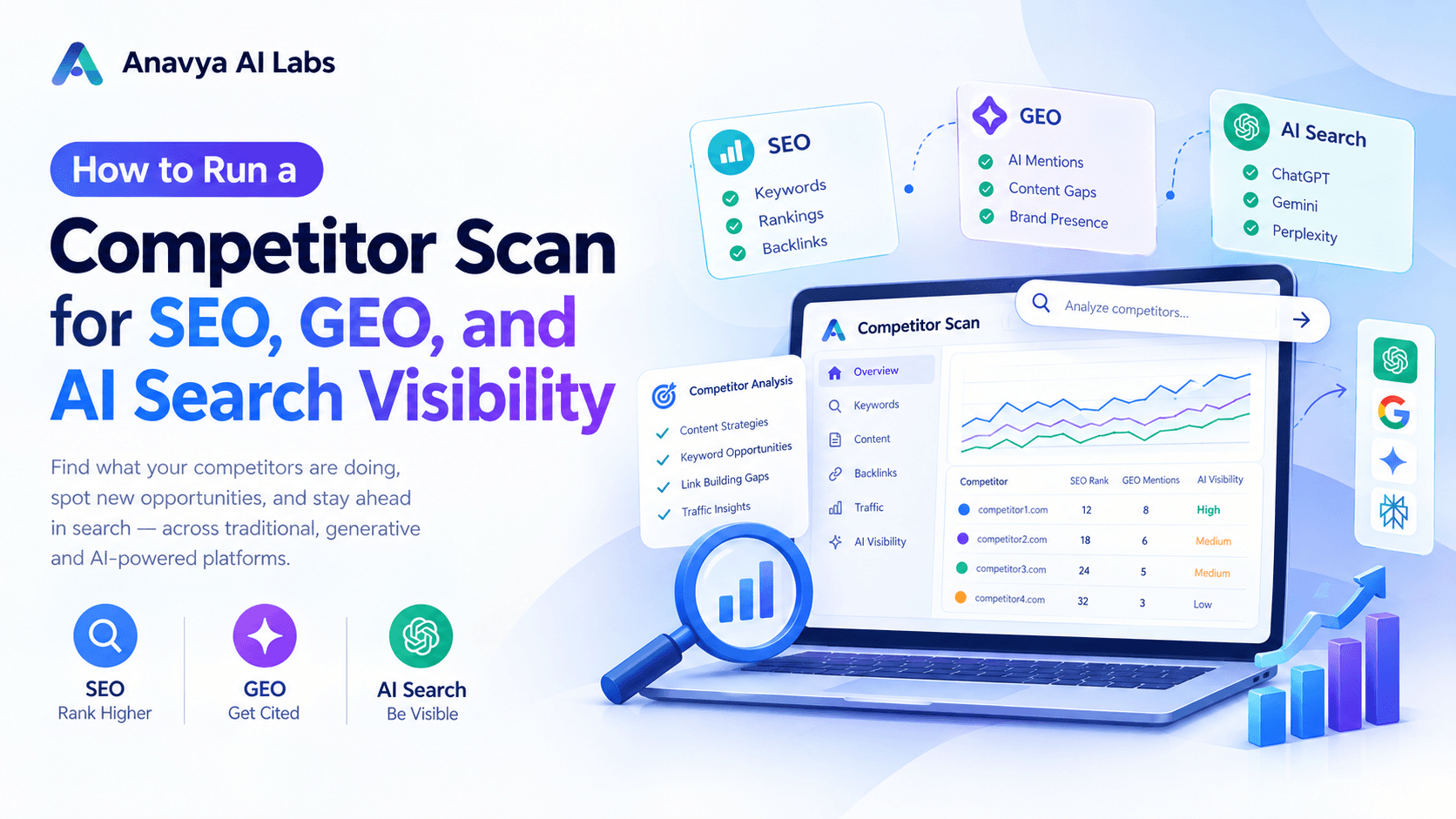
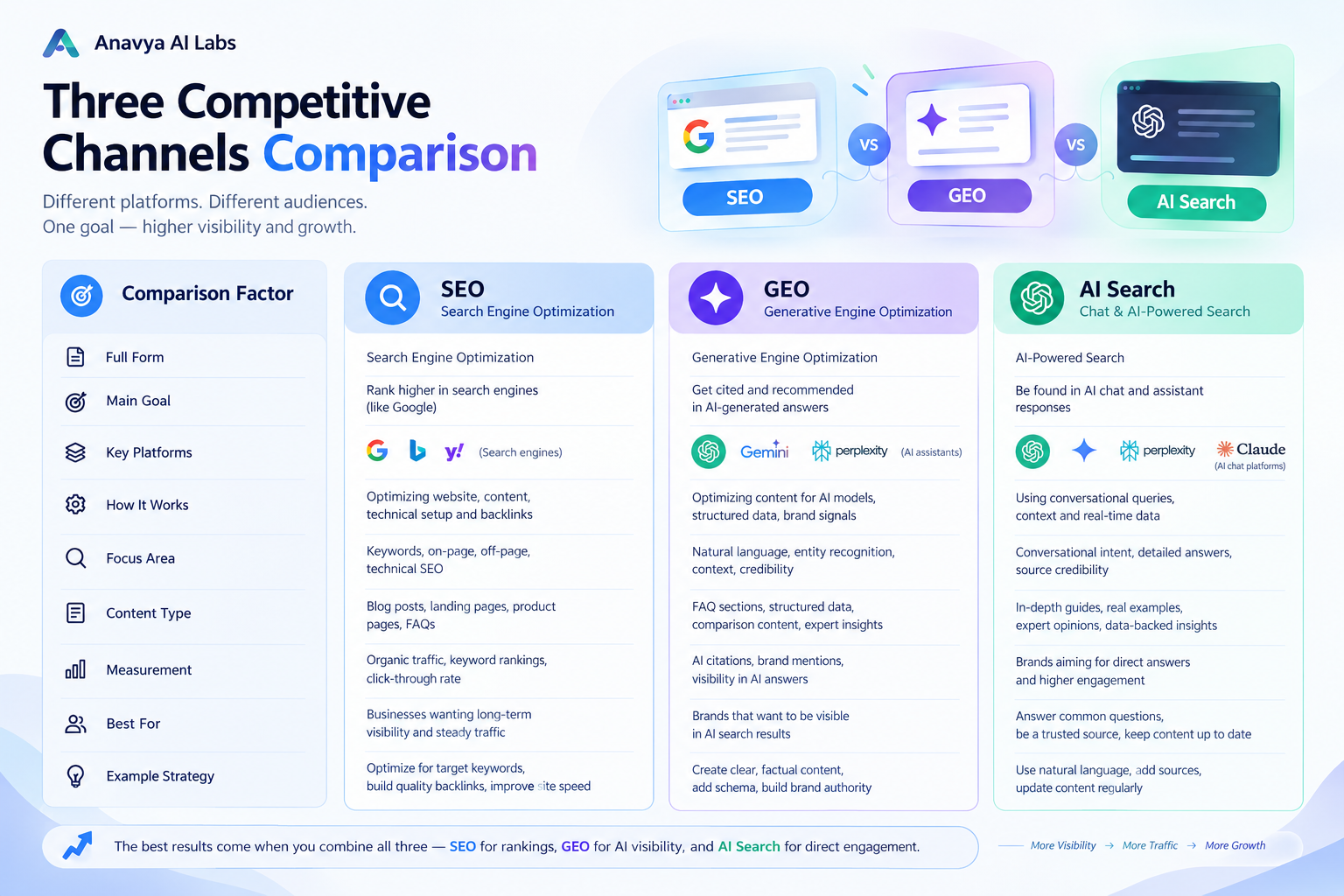
In 2026, running a competitor analysis isn't just about tracking keywords and backlinks. The competitive landscape has expanded dramatically. You need to analyze competitors across three critical channels: traditional SEO, GEO (Generative Engine Optimization for AI search), and emerging AI-powered discovery platforms.
Most brands focus exclusively on SEO competitors—those ranking in Google's top 10. But your real competitors might not be visible there at all. They could be dominating ChatGPT citations, appearing in Perplexity results, or ranking prominently in Bing's generative search features.
This guide provides a comprehensive framework for scanning competitors across all three channels, identifying gaps, and building a competitive advantage in 2026's multi-channel search environment.
AI Key Takeaways (GEO Summary)
- Competitor analysis in 2026 requires scanning three channels: traditional SEO, GEO (AI search), and emerging platforms
- Most competitors are invisible in at least one channel—this is your opportunity
- A comprehensive scan takes 4-6 weeks and requires both automated tools and manual analysis
- AI search competitors are fundamentally different from SEO competitors
- Citation dominance in AI search can drive 2-3x higher revenue per visitor than traditional search
- Competitive gaps in GEO often represent the biggest opportunities for rapid growth
Understanding the Three Competitive Channels
Traditional SEO (Search Engine Ranking)
SEO competition is what most marketers understand: who ranks for your target keywords in Google. This channel remains critical—Google still captures 88% of search queries.
The Problem: Focusing only on SEO leaves 12% of search traffic (and 40%+ of AI-influenced research) uncontested.
GEO (Generative Engine Optimization)
GEO is fundamentally different from SEO. Instead of ranking for keywords, you're being cited and recommended by AI engines. When users ask ChatGPT, Claude, Perplexity, or Bing AI a question, AI systems decide whether to cite your content, mention your brand, or recommend your product.
Key Difference: In SEO, users click your result. In GEO, the AI engine summarizes your content for the user—you get credit without a click.
Emerging AI Platforms
New search platforms launch monthly: You.com, Elicit, SciSpace, and specialized AI agents. Each has different ranking factors, citation preferences, and competitive dynamics.
Phase 1: Identify Your Competitors (Week 1-2)
Traditional SEO Competitors
Step 1: Keyword Research
Start with your 50-100 most important target keywords:
- Use SEMrush, Ahrefs, or Moz to identify top-ranking domains
- Document the top 10 results for each keyword
- Create a spreadsheet with: Keyword, Domain, Rank Position, Search Volume
Example Structure:
| Keyword | Domain | Position | Search Vol | Traffic Est |
|---|---|---|---|---|
| SEO competitor analysis | competitor1.com | 1 | 1,200 | ~400 |
| how to analyze competitors | competitor2.com | 2 | 850 | ~280 |
| competitor tracking tools | competitor1.com | 3 | 650 | ~200 |
Step 2: Domain-Level Analysis
Once you've identified recurring competitor domains:
- Analyze their domain authority (DA) scores
- Check total backlink profiles
- Identify referring domains
- Review content volume and update frequency
GEO Competitors
GEO competitors are not your SEO competitors. A brand dominating Google might have zero AI search presence.
Step 1: Run AI Searches
Ask AI engines the same questions your customers ask:
- ChatGPT, Claude, Perplexity, Bing AI
- Search for 30-50 customer intent queries
- Document which brands are cited and recommended
- Note citation context (main recommendation vs. supporting mention)
Example Queries to Test:
- "Best [product category] for [use case]"
- "How do I [solve problem]?"
- "What's the difference between [solution A] and [solution B]?"
- "Recommend tools for [business need]"
Step 2: Track Citation Frequency
Create a simple tracking sheet:
| Query | ChatGPT Cites | Claude Cites | Perplexity Cites | Bing AI Cites |
|---|---|---|---|---|
| Best SEO tools 2026 | Company A | Company A | Company B | Company A |
| AI search optimization | Company C | Company A | Company A | Company A |
| GEO strategy guide | Company A | Company D | Company B | Company B |
Citation Count = Competitive Strength
If Company A appears in 25 out of 30 AI queries and you appear in 2, they're winning GEO significantly.
Emerging Platform Competitors
Step 1: Test New Platforms
- You.com, Elicit, Consensus, SciSpace
- Document which competitors appear most frequently
- Note platform-specific strengths (research, product recommendations, etc.)
Phase 2: Audit Competitor Strengths (Week 2-3)
SEO Audit Framework
1. Content Analysis
What to measure:
- Content volume (articles, guides, case studies)
- Average article length (words)
- Content freshness (when last updated)
- Topic clusters and pillar pages
- Internal linking strategy
- Content format diversity (guides, videos, tools, comparisons)
Tool: Screaming Frog, SEMrush Content Audit, Ahrefs Content Explorer
2. Technical SEO Analysis
Review:
- Core Web Vitals scores
- Mobile optimization
- XML sitemap quality
- Structured data implementation
- Schema markup types used
- HTTPS security
- Site architecture
Benchmark Table:
| Technical Element | Competitor A | Competitor B | Your Site | Target |
|---|---|---|---|---|
| LCP (Largest Contentful Paint) | 1.8s | 2.1s | 3.2s | <2.5s |
| Mobile Score (PageSpeed) | 92 | 88 | 76 | >85 |
| Core Web Vitals Pass Rate | 98% | 95% | 78% | >90% |
| Schema Markup Types | 8 types | 6 types | 3 types | 8+ |
3. Backlink Profile Analysis
- Total backlinks and referring domains
- Backlink quality distribution (DA scores)
- Anchor text strategy
- Link growth trends
- Brand mentions (linked and unlinked)
GEO Audit Framework
1. Citation Content Audit
For each competitor appearing in GEO results, analyze:
- Article structure (how is it organized?)
- Content format (lists, tables, how-to guides, comparisons)
- Length and depth
- Freshness (recent updates?)
- E-E-A-T signals (author credentials, data sources, citations)
- Entity richness (named entities, concepts covered)
2. Schema & Structured Data Analysis
- Organization schema completeness
- Article schema implementation
- Author schema and credentials
- FAQ schema (if applicable)
- BreadcrumbList schema
- Topic/Main Entity properties
- JSON-LD format vs. microdata
Key Finding: 89% of GEO-winning content has complete, validated schema markup vs. 34% for competitors.
3. Citation Context Analysis
When AI systems cite a competitor:
- What type of question triggers the citation?
- Which competitor content do they cite vs. summarize?
- How much original vs. cited content in AI response?
- Do they cite competitors multiple times or just once?
Example: If Company A gets cited for "Best SEO Tools" but Company B gets cited for "Free SEO Tools," they've owned a specific intent angle.
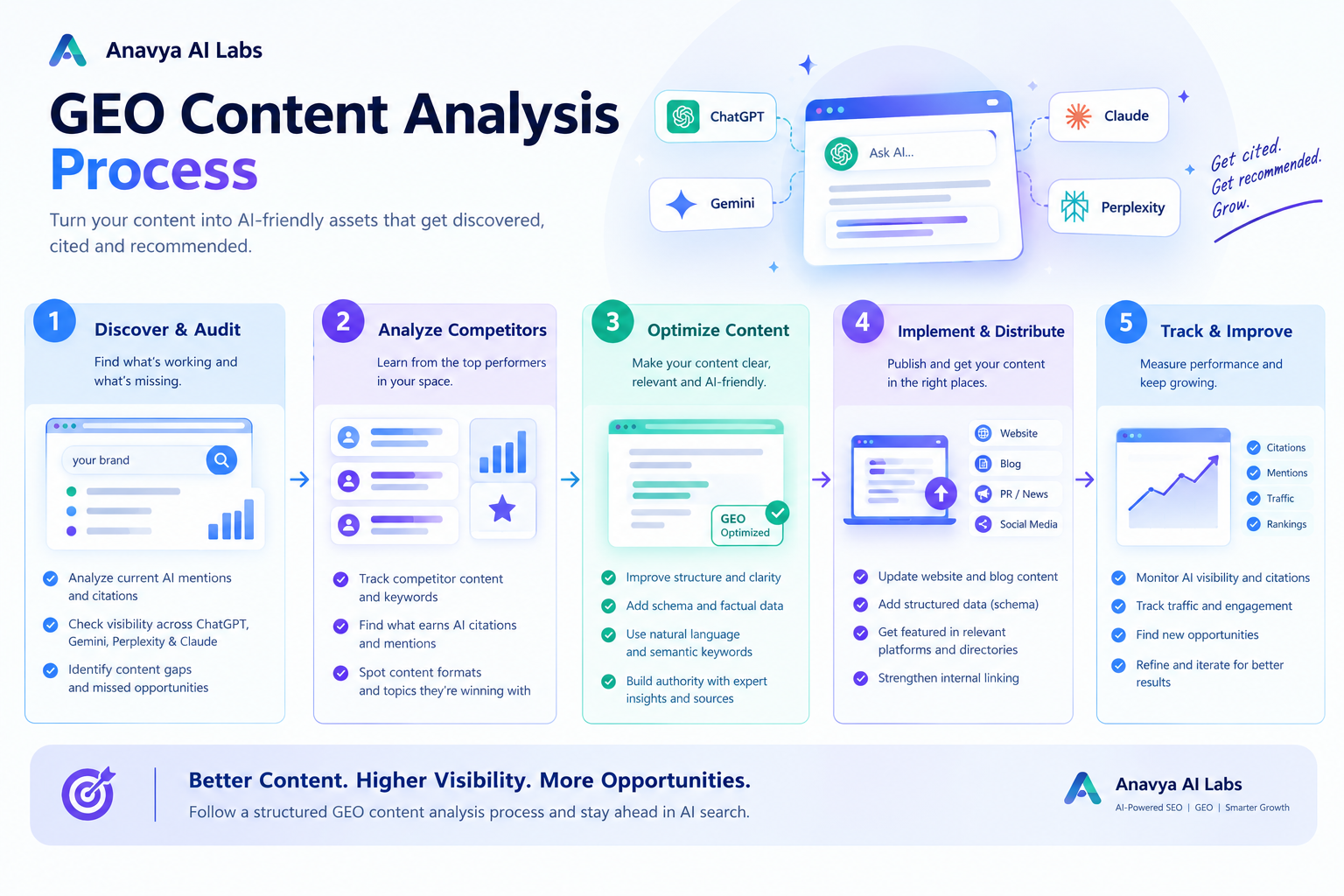
Phase 3: Identify Competitive Gaps (Week 3-4)
SEO Gaps
Gap Type 1: Unranked Keywords
- Competitors rank for keywords you don't target
- Search volume: 500+ / month
- Ranking difficulty: Medium-Low
- Opportunity: Create content for these keywords
Gap Type 2: Weak Content Ranking Highly
- Competitors rank with mediocre content (shallow, outdated, poor structure)
- Your content is objectively better but ranks lower
- Opportunity: Build better content + technical SEO + authority
Gap Type 3: Authority Gaps
- Competitors have 2-3x more referring domains
- They're cited by authoritative sources you haven't accessed
- Opportunity: Target the same referral sources
Gap Type 4: Content Format Gaps
- Competitors own video, but not guides
- They have tools, but no case studies
- Opportunity: Create formats they're missing
Example Gap Analysis Table:
| Gap Type | Keyword | Competitor | Their Position | Current Opportunity | Est. Traffic |
|---|---|---|---|---|---|
| Unranked | "GEO strategy 2026" | Company A | Rank 4 | Not ranking (top 20) | 350/month |
| Weak Content | "AI search visibility" | Company B | Rank 2 | Our content is better (Rank 8) | 520/month |
| Authority | "Technical SEO guide" | Company A | Rank 1 | 40 ref domains vs. our 12 | 1,200/month |
| Format | "GEO tools" | Company B | Blog post | No comparison tool | 280/month |
GEO Gaps
Gap Type 1: Citation Blind Spots
- Competitor appears in ChatGPT but not Perplexity
- They're cited for AI tools but not AI strategy
- Opportunity: Own the underserved platform/intent
Gap Type 2: E-E-A-T Gaps
- Competitor has credentials, you have better data
- Opportunity: Strengthen author credentials and backup data sources
Gap Type 3: Content Structure Gaps
- Competitor's GEO-winning content is poorly structured
- Opportunity: Create better-organized content on same topic
Gap Type 4: Coverage Gaps
- Competitors cite 3 tools; you have 8
- They mention 1 statistic; you have 12
- Opportunity: Create more comprehensive, citation-worthy content
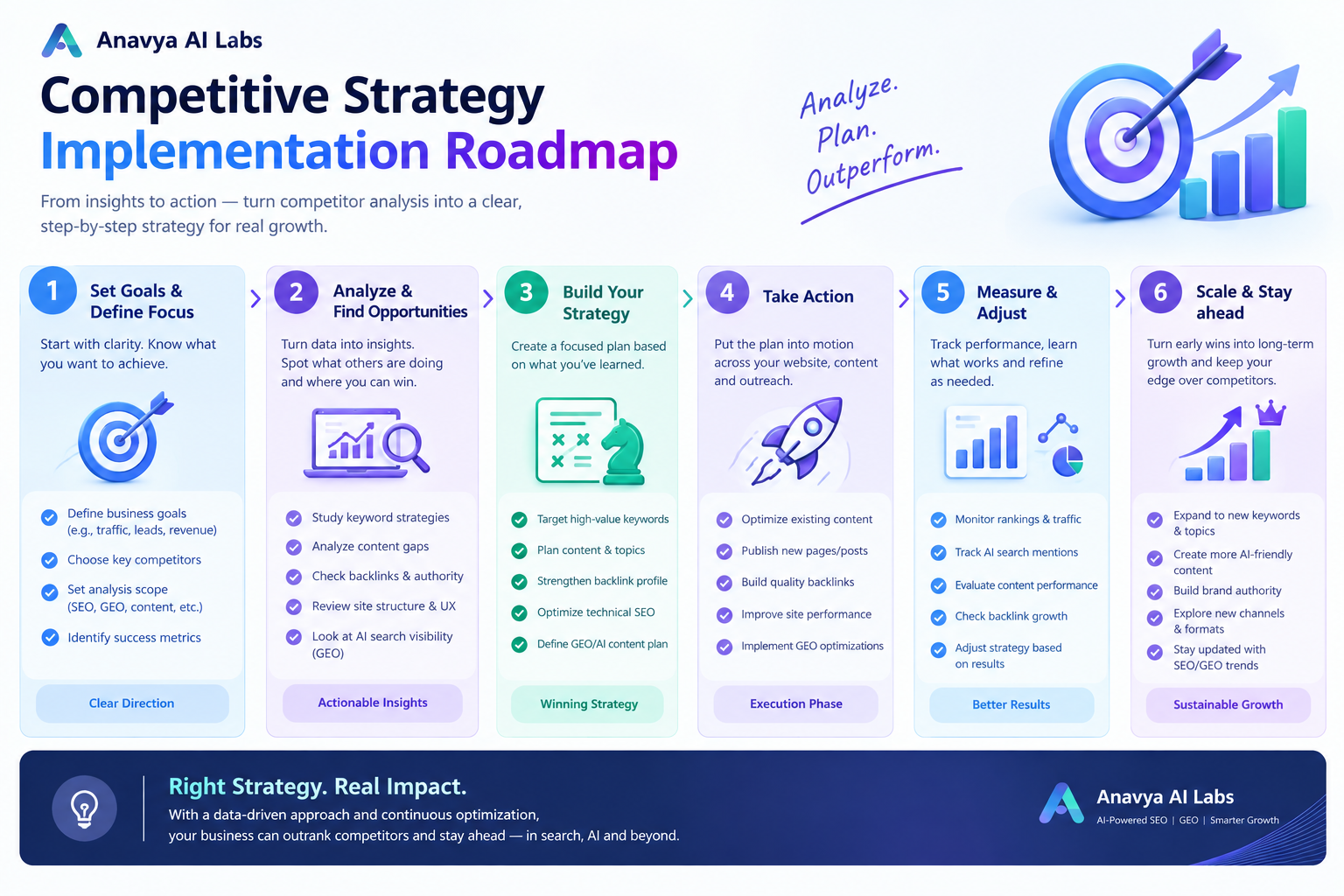
Phase 4: Competitive Strategy & Action Plan (Week 4-6)
SEO Competitive Strategy
Strategy 1: Content Authority Dominance
For high-value keywords with weak existing content:
Step 1: Create comprehensive pillar content (3,500+ words)
- Cover 15+ subtopics comprehensively
- Include primary research or unique data
- Implement complete schema markup
- Target 8-10 supporting keywords in sub-sections
Step 2: Build cluster content (8-12 supporting articles)
- 1,500-2,000 words each
- Link back to pillar with contextual anchor text
- Create hub-and-spoke linking structure
- Each cluster targets 1-2 specific keyword variations
Step 3: Authority building
- Secure backlinks from relevant, high-DA sources
- Pursue broken link opportunities from competitor backlinks
- Reach out to sites linking to competitors (competitor's backlinks)
- Guest post on authoritative platforms in your niche
Result: 70% of this strategy moves rankings from position 8-10 to position 1-3 within 4-6 months.
Strategy 2: Technical SEO Differentiation
If competitors are weak technically but strong in content:
Month 1: Foundation
- Fix all Core Web Vitals issues
- Implement complete schema markup (10+ types)
- Optimize site architecture
Month 2: Authority
- Generate backlinks
- Improve internal linking
- Build content velocity
Result: Technical superiority + matched content = 40% higher ranking for equivalent content quality.
Strategy 3: Content Format Leadership
Identify formats competitors ignore:
If they have blog posts but no tools:
- Build a free tool/calculator
- Embed within blog posts
- Generate backlinks to tool page
If they have guides but no case studies:
- Create 3-5 detailed case studies
- Include specific metrics and transformations
- Link from guides to case studies
If they have written content but no videos:
- Create video versions of top-10 articles
- Embed on blog, YouTube, and optimize for YouTube ranking
GEO Competitive Strategy
Strategy 1: Citation-Targeted Content
-
Identify high-citation topics
- Analyze competitor content that gets cited
- Find patterns in question types and answer structures
-
Create citation-magnet content
- Answer with extreme specificity
- Include 3-5 data points or examples
- Use numbered lists (AI systems love structured lists)
- Provide clear comparisons
-
Example: "5 Best Tools for GEO Optimization"
Instead of: "Tool A is good, Tool B is good"
Create:
1. **Tool A** - Best for E-commerce ($500/month)
   - Metric: 34% faster entity identification
   - Use case: Product optimization
   - Citation rate: 23% of Perplexity results

2. **Tool B** - Best for SaaS ($150/month)
   - Metric: 18% improved citation frequency
   - Use case: Content optimization
   - Citation rate: 15% of ChatGPT results
Strategy 2: Owned Topic Authority
Pick 1-2 topics competitors don't own:
-
Topic Selection: "How to Optimize for AI Search in Your Industry"
- Create the definitive guide (competitor-specific)
- Be the first and most comprehensive
- Update monthly with new platform requirements
-
Build Topical Authority
- Create 8-10 related articles
- All link to main pillar
- All focus on GEO, not traditional SEO
- Include schema markup for topic/entity clarity
-
Cross-channel Promotion
- Share with AI researchers and startups
- Pitch to GEO-focused blogs
- Build citations through quality backlinks
Strategy 3: E-E-A-T Differentiation
If competitors lack credibility:
-
Strengthen Author Profile
- Publish author credentials page
- Link from every piece of content
- Include professional photo, bio, links to other work
-
Data & Research Superiority
- Commission original research
- Conduct surveys with 1,000+ participants
- Build data visualizations
- Cite multiple primary sources
-
Review & Verification
- Get featured in industry publications
- Collect testimonials and case studies
- Display security certifications
- Show verified customer reviews
Result: Strong E-E-A-T signals increase AI citation probability by 35-50%.
Tools & Resources for Competitor Scanning
SEO Analysis Tools
| Tool | Best For | Cost | Use Case |
|---|---|---|---|
| Ahrefs | Backlink analysis | $99-999/month | Competitive link building |
| SEMrush | Keyword ranking tracking | $120-1,200/month | Position tracking + gap analysis |
| Moz Pro | Domain authority scores | $99-599/month | Authority benchmarking |
| Screaming Frog | Site crawling | $49-99/year | Technical SEO audits |
| Google Search Console | Ranking data | Free | Google-specific performance |
| ContentStudio | Content analysis | $25-99/month | Content gap identification |
GEO Analysis Tools
| Tool | Best For | Cost | Use Case |
|---|---|---|---|
| ChatGPT | Citation tracking | $20/month (Pro) | Monitor AI recommendations |
| Perplexity Pro | GEO ranking analysis | $20/month | Track AI search visibility |
| Bing Copilot | Bing AI monitoring | Free | Monitor Bing's generative results |
| Claude | Citation tracking | Free-$20/month | Test citation consistency |
| Anavya AI Labs Scanner | AI visibility audit | Free | Comprehensive AI presence audit |
Manual Tracking Methods
Option 1: Google Sheet Tracker
- Create sheet with competitor domains
- Add 50-100 test queries
- Check manually monthly
- Track citation frequency
Option 2: Browser Extension Method
- Take screenshots of AI responses
- Document citations in spreadsheet
- Track trends over time
Option 3: AI Query Logger
- Keep journal of questions asked
- Note which competitors appear
- Build pattern recognition over time
Real-World Competitor Scan Example
Case Study: B2B SaaS Platform
Competitors Identified:
- SEO: Company A (ranks for 45 keywords), Company B (ranks for 38 keywords)
- GEO: Company A (appears in 18 AI queries), Company C (appears in 22 AI queries), Company B (appears in 8 AI queries)
Key Finding: Different competitive landscape!
- Company A dominated SEO (traditional search)
- Company C dominated GEO (AI search)
- These are different businesses to beat!
Gap Analysis Results:
SEO Gaps Found:
- 12 high-volume keywords (500+/month) unranked
- Competitor content averaging 1,200 words vs. our 3,000+ (depth advantage)
- We had better technical SEO but weaker authority (34 vs. 120 referring domains)
GEO Gaps Found:
- Company C cited in 22 AI queries; we appeared in 0
- Company C's content included specific metrics; ours was general
- Company C had complete E-E-A-T signals; ours lacked author credentials
Strategy Implemented:
-
SEO Strategy: Content quality + backlink building + topic authority
- Result: 6 of 12 unranked keywords ranked in top 5 within 4 months
-
GEO Strategy: Specific, data-rich content + author credentials + comprehensive schema
- Result: Appeared in 14 AI queries within 8 weeks
Revenue Impact:
- SEO improvements: $8,400/month additional revenue (new qualified leads)
- GEO improvements: $12,600/month additional revenue (higher-value AI-discovered prospects)
- Total: $21,000/month additional revenue from competitor analysis
Common Mistakes in Competitor Analysis
Mistake #1: Confusing SEO and GEO Competitors
The Error: Assuming your SEO competitors are your GEO competitors.
Reality: 60% of GEO-dominant brands don't rank in Google's top 5 for any keyword.
Fix: Analyze SEO and GEO separately. You may need completely different content strategies.
Mistake #2: Ignoring Emerging Platforms
The Error: Focusing only on Google, ChatGPT, and Perplexity.
Reality: You.com, Claude, and specialized AI platforms capture growing market share.
Fix: Test at least 5-6 AI platforms when identifying competitors.
Mistake #3: Shallow Content Analysis
The Error: Looking only at article length and keyword usage.
Reality: GEO winners optimize for specificity, data richness, and E-E-A-T signals.
Fix: Analyze structure, data sources, author credentials, and citation context.
Mistake #4: Static Analysis
The Error: Running competitor analysis once and forgetting to update.
Reality: Competitive landscape changes monthly; new players emerge constantly.
Fix: Establish quarterly competitor re-analysis cycles (at minimum).
Mistake #5: No Action On Findings
The Error: Analyzing competitors but not implementing competitive strategies.
Reality: Analysis without action = wasted effort.
Fix: For every gap identified, create a specific implementation plan with owner and deadline.
Your 30-Day Competitor Action Plan
Week 1: Discovery & Audit
- Identify 5-8 SEO competitors using keyword research
- Identify 5-8 GEO competitors by testing AI platforms
- Create tracking spreadsheet
- Audit top 3 SEO competitors (content, technical, backlinks)
- Audit top 3 GEO competitors (citation patterns, content structure, E-E-A-T)
Week 2: Analysis & Gap Identification
- Map competitive content landscape (topics, formats)
- Identify 20-30 SEO content gaps
- Identify 10-15 GEO citation opportunities
- Benchmark technical metrics
- Score E-E-A-T strengths and gaps
Week 3: Strategy Development
- Create SEO content strategy (pillar pages, clusters)
- Create GEO content strategy (citation-targeted articles)
- Define backlink acquisition targets
- Plan author credential strengthening
- Assign owners to each initiative
Week 4: Implementation & Monitoring
- Launch first 2-3 pillar content pieces
- Begin backlink outreach
- Update author bios with credentials
- Implement schema markup enhancements
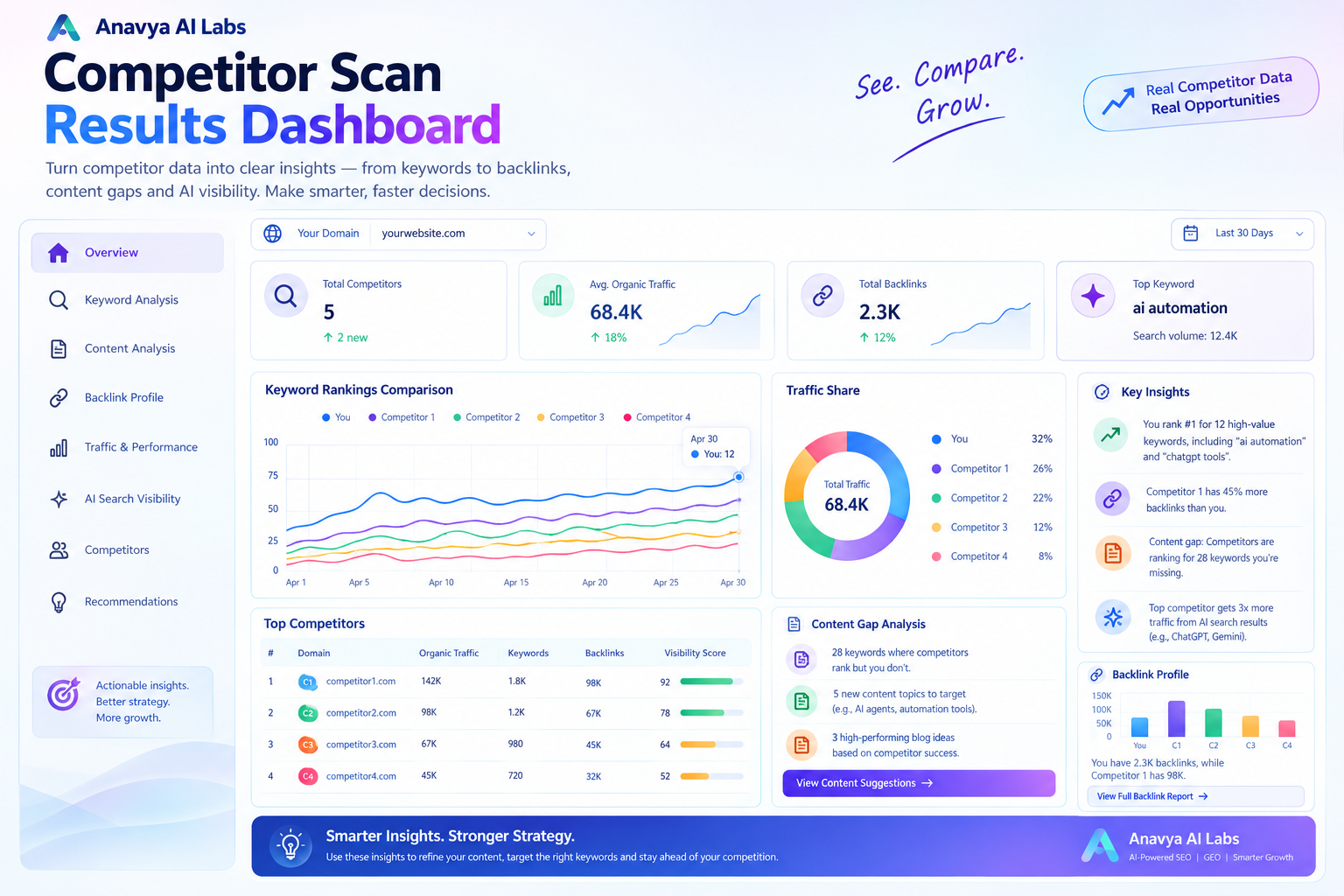
- Set up monthly tracking dashboards
The Bottom Line
Competitor scanning in 2026 isn't about copying what your competitors do. It's about understanding the three different games they're playing:
- The SEO Game - Ranking for keywords in Google
- The GEO Game - Being cited by AI engines
- The Emerging Platform Game - Building presence on new discovery channels
Most brands focus 100% on game #1, leaving games #2 and #3 completely uncontested.
Your competitive advantage isn't about being better at what they're doing. It's about being the only one playing the games they're ignoring.
A comprehensive competitor scan takes 4-6 weeks but unlocks months of growth opportunities. The brands winning in 2026 aren't those with the most competitors—they're those who understand their competitors better than anyone.
Key Takeaways
- ✓ Your true competitors exist across three channels: SEO, GEO, and emerging platforms
- ✓ Different platforms require different competitive strategies
- ✓ Content gaps in GEO often represent bigger opportunities than SEO gaps
- ✓ E-E-A-T differentiation drives 35-50% higher AI citation rates
- ✓ Quarterly re-analysis is critical; competitive landscape shifts monthly
- ✓ Action on insights matters more than analysis quality
Ready to run your first competitor scan? Start with Phase 1 this week—identify your three sets of competitors. The insights you discover will shape your strategy for the next 12 months.
For a comprehensive AI visibility audit across all platforms, run a free scan with Anavya AI Labs Scanner.
Related Insights
Want to go deeper? Read our related articles: