
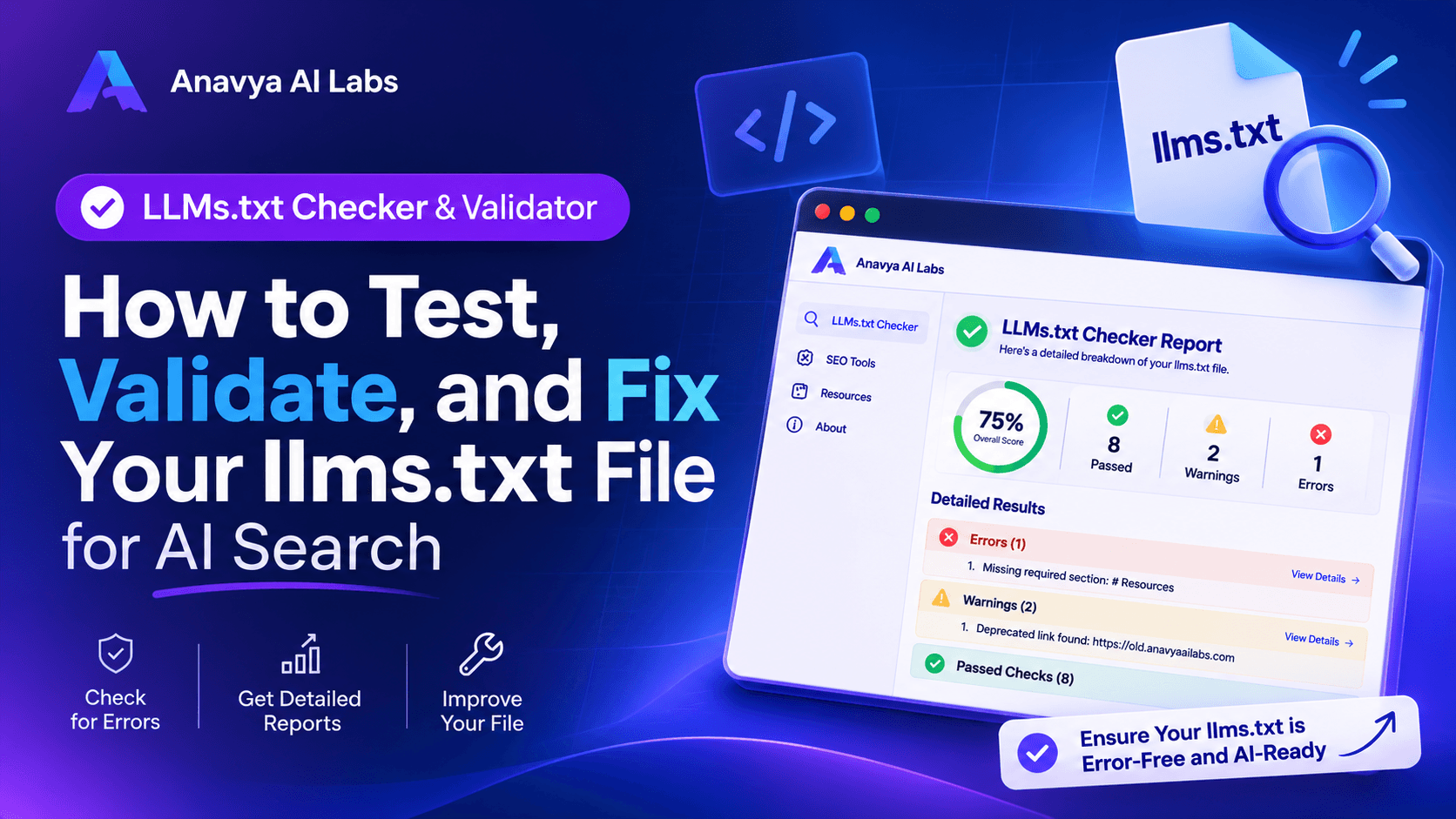
A small error in an llms.txt file can be easy to miss. A heading uses the wrong level, a bracket is left open, or a link points to a page that was moved last month. None of these problems appears on the live site, yet each one can make the file harder to read for people and for any system that uses it.
A free llms.txt checker helps you find these problems quickly. It fetches your file, tests its structure, follows its links, and reports what it finds. This guide explains what a checker should test, how to run one, how to read the report, and how to fix the errors it finds. It also covers the limits of automated checking, because a file can pass every technical test and still be out of date.
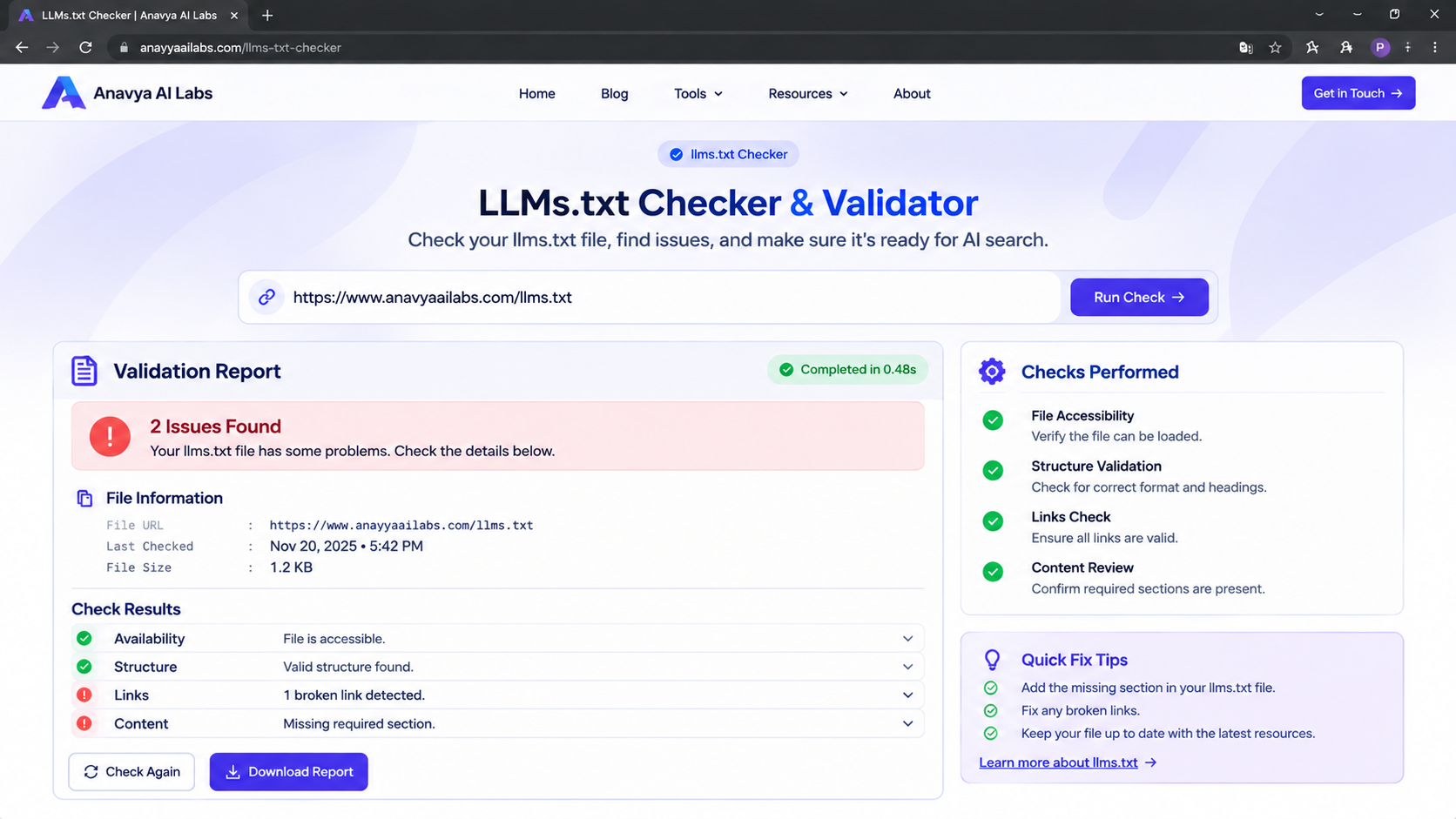
A checker reads the file the way a parser would, then reports each problem with enough detail to fix it.
What a Checker Needs to Test
llms.txt is a proposed convention for giving language models a curated, Markdown-based overview of a website. The proposal describes the expected layout, but there is no single official validator for it. A useful checker therefore tests the same four areas that a careful human reviewer would examine.
The first area is availability. The file must be reachable at /llms.txt on the root of your domain, return a successful status code, and be served as text.
The second area is structure. The file should begin with an H1 title, include a blockquote summary, group its links under H2 sections, and format each link as a list item with a title, a URL, and an optional description.
The third area is links. Every URL should be absolute, should load successfully, and should not redirect unnecessarily. Duplicate entries are worth flagging as well.
The fourth area is content. The summary and descriptions should match the site as it exists today. A checker cannot judge this fully, but it can flag signals that suggest a problem, such as a link to a page that no longer exists or a description that repeats the page title without adding information.
A checker that covers all four areas gives you a much more reliable result than one that only confirms the file exists.
Types of Errors and What They Mean
Errors fall into a few predictable groups. Knowing the group helps you decide how urgent the fix is and where to look for the cause.
Access errors prevent the file from being read at all. Examples include a 404 status because the file is in the wrong location, a 403 status caused by a permissions rule, a 500 status caused by a server problem, or a response served as HTML rather than text. These are the most urgent, because nothing else can be checked until the file loads.
Structural errors change how the file is interpreted. A missing H1 title, a summary that is written as a plain paragraph instead of a blockquote, or a link line that does not follow the expected pattern can all cause a parser to misread the file. These errors are usually quick to fix, but they should not be ignored, because they affect every entry that follows.
Link errors point to resources that cannot be used. A link that returns a 404 or 410 status leads to a dead end. A link that returns a server error may be temporary, but it still needs investigation. A redirect is not always an error, but it adds a step that the file does not need.
Quality warnings do not necessarily break the file, but they reduce its value. Duplicate URLs, very long lists, and a missing Optional section for lower-priority links are typical examples. Fix these to keep the file focused and easy to use.
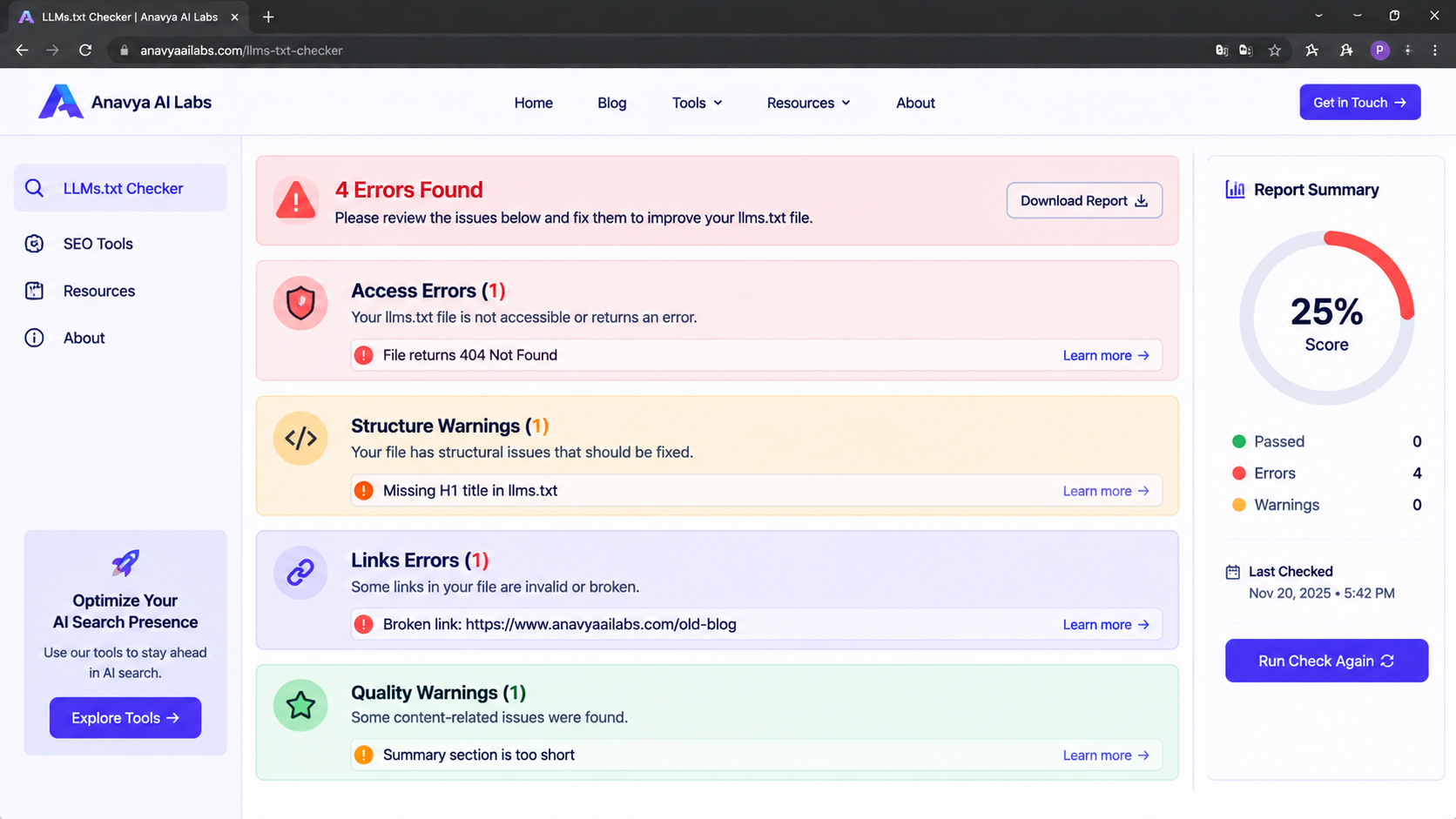
Access errors come first, because nothing else can be checked until the file loads.
Step 1: Confirm the File Loads
Begin with the simplest test. Request the file and record the status code and content type.
curl -s -o /dev/null -w "%{http_code} %{content_type}\n" https://www.yourdomain.com/llms.txt
A status of 200 means the file was found and returned successfully. A 301 or 302 means the server is redirecting, which is acceptable only if the final destination is the file itself. A 404 means the file is not at that path. A 403 can indicate a permissions or access rule, and a 500 points to a server error that needs attention before anything else.
The content type should indicate text, such as text/plain or text/markdown. If it returns text/html, the server may be sending an error page, a login screen, or a redirect target in place of the file. This often happens when a framework route or a rewrite rule intercepts the request.
Also confirm that your robots.txt file does not block the path. A broad rule can prevent access to llms.txt along with everything else. If the file exists in your project but not on the live site, check the deployment, the build output, and the public folder configuration before editing the file itself.
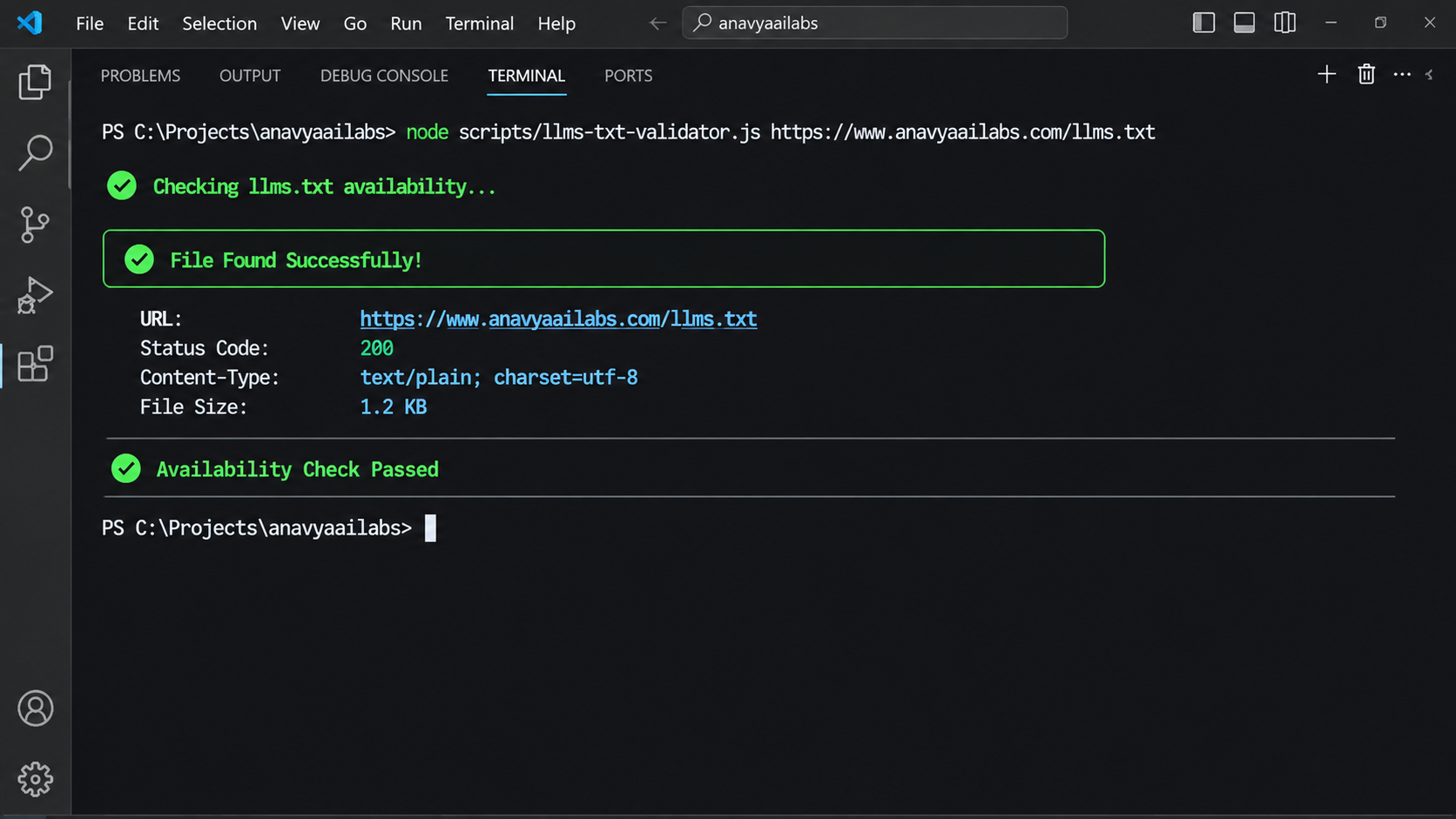
Confirm the status code and content type before you examine the contents of the file.
Step 2: Check the Structure
A correctly structured file follows a predictable layout. Here is a short example for a fictional company.
# Example Analytics

> Example Analytics provides website measurement software for small and mid-sized businesses. It tracks traffic, conversions, and search performance in one dashboard.

## Documentation

- [Getting started](https://www.example.com/docs/getting-started): Installation steps and first-time setup
- [Reporting](https://www.example.com/docs/reporting): How to build dashboards and schedule reports

## Products

- [Pricing](https://www.example.com/pricing): Plans, usage limits, and billing terms

## Optional

- [Company history](https://www.example.com/about): Background on the team and founding
A checker should confirm several things in this example. The first non-empty line is an H1 heading. The summary is a blockquote. Sections use H2 headings. Each link line begins with a dash, followed by the title in square brackets, the URL in parentheses, and an optional colon and short description. If an Optional section is used, its heading is spelled exactly as shown.
Structural errors often look trivial in the file but matter to a parser. A title written with two hash marks instead of one, a summary written as plain text, a link with a missing closing parenthesis, or a line that begins with an asterisk instead of a dash can all cause the file to be read incorrectly. When you find one, fix the pattern once, then check whether the same mistake appears elsewhere in the file.
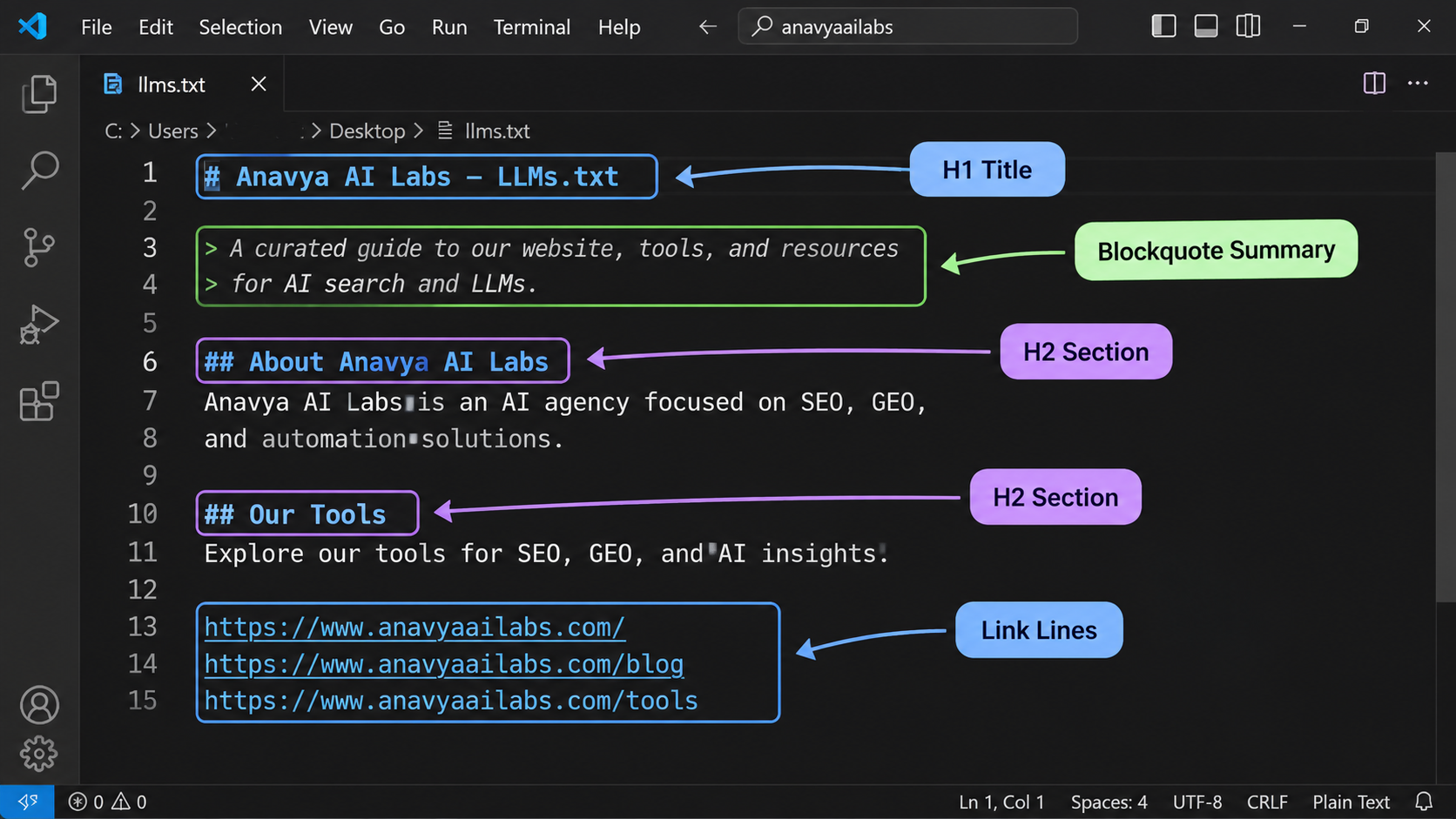
The layout is simple, which makes deviations easy to spot once you know the correct pattern.
Step 3: Test Every Link
Every link should load, lead to the page its description promises, and use the address that the site publishes today. Broken links are the most common problem in files that were correct when first written.
You can test links manually by extracting the URLs and requesting each one:
grep -o 'https\?://[^)]*' llms.txt | xargs -I {} curl -s -o /dev/null -w "%{http_code} {}\n" {}
Read the results carefully. A 200 response is correct. A redirect is acceptable, but the file should point to the final address so readers and tools do not need to follow the redirect. A 404 or 410 means the page no longer exists, and the entry should be removed or replaced with a current page. A 5xx response may be temporary, so retest it before changing anything.
Check for duplicate URLs as well. A page listed twice under different sections adds noise without adding information. Keep the entry in the section where it belongs most clearly, and remove the other.
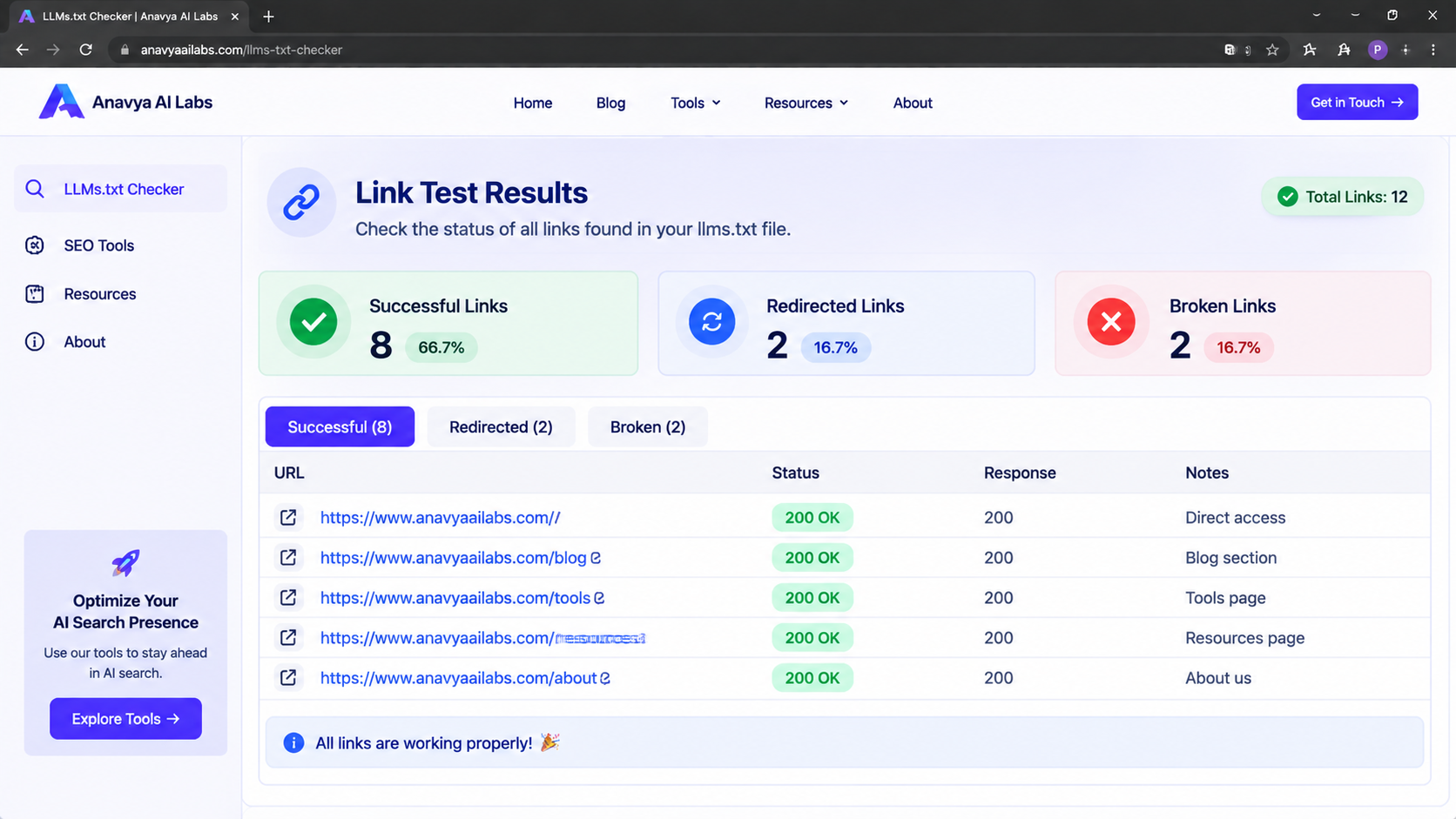
Each status code points to a different action: keep it, update it, or remove it.
Step 4: Read the Report
A checker report is most useful when you read it in a fixed order. Start with access, then structure, then links, then quality. This sequence matters because a problem higher in the list can hide others. A file that does not load cannot be checked for links, and a broken title can make every later line look wrong.
Within each group, read the messages from top to bottom. Many reports list the line number or the URL that triggered each message. Use that information to find the exact location in the file, rather than searching for a general pattern.
Separate errors from warnings. Errors indicate problems that should be fixed before the file is relied upon. Warnings indicate issues that reduce quality or may cause trouble later. Both are worth attention, but errors take priority.
Finally, look at the summary line. A report that says the file passed with warnings is different from one that says it failed with errors, and the summary tells you which situation you are in before you read the details.
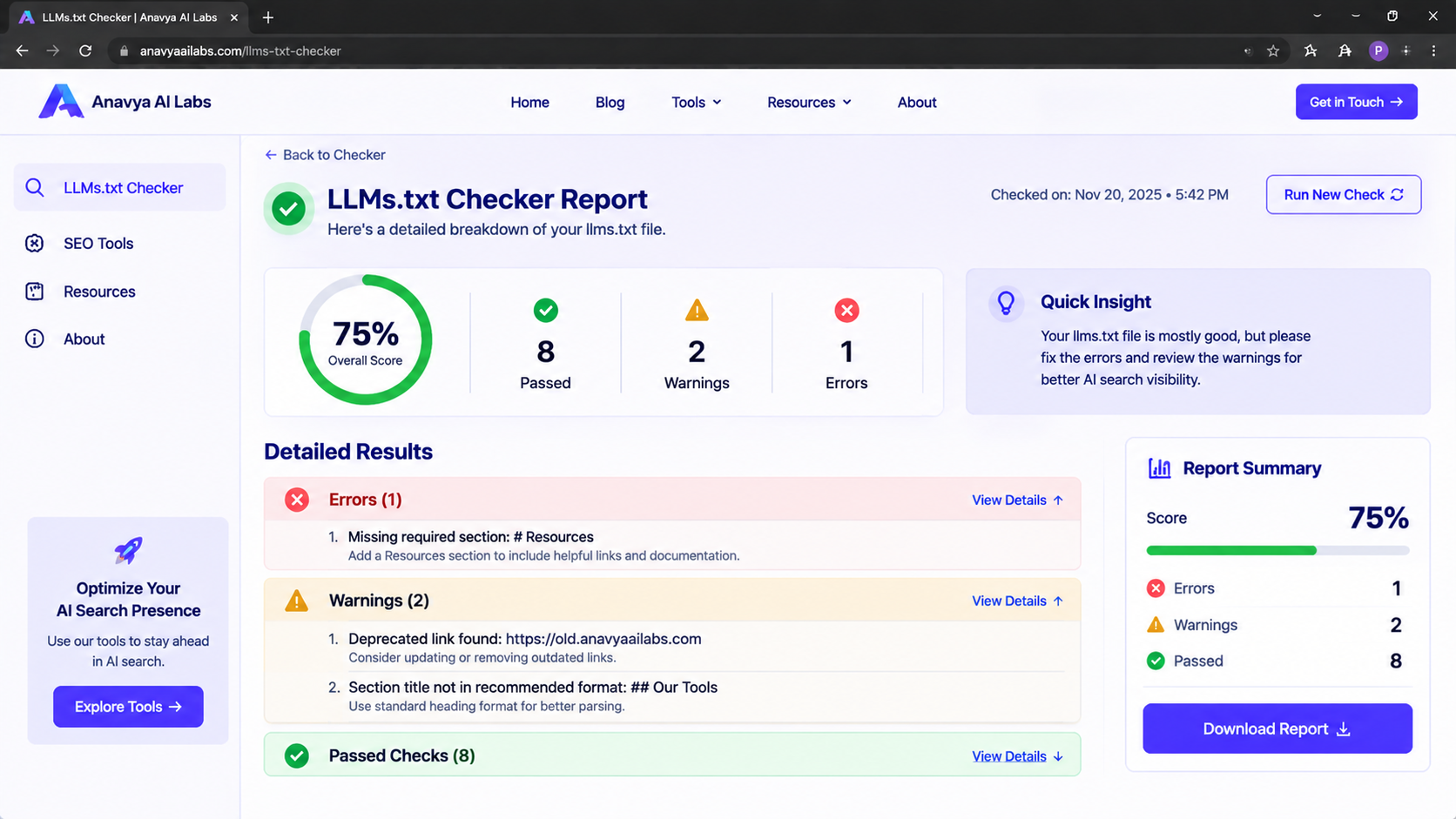
Work through the report in order: access, structure, links, then quality, because each stage depends on the one before it.
A Checker Script
If you prefer to run the checks yourself, the following script covers availability, structure, and link testing. It requires the requests library, which you can install with pip install requests. It is a practical starting point rather than a complete parser, so treat its output as a prompt for review.
import re
import sys
import requests

LINK_LINE = re.compile(
    r"^- \[(?P<title>[^\]]+)\]\((?P<url>https?://[^)\s]+)\)(?::\s*(?P<note>.+))?$"
)
HEADING = re.compile(r"^(#{1,6})\s+(.+)$")


def check(site, check_links=True):
    errors = []
    warnings = []
    base = site.rstrip("/")

    try:
        response = requests.get(f"{base}/llms.txt", timeout=15)
    except requests.RequestException as error:
        return [f"Could not fetch llms.txt: {error}"], []

    if response.status_code != 200:
        return [f"llms.txt returned HTTP {response.status_code}"], []

    content_type = response.headers.get("Content-Type", "")
    if "text" not in content_type:
        warnings.append(f"Unexpected Content-Type: {content_type}")

    lines = [line.strip() for line in response.text.splitlines() if line.strip()]
    if not lines:
        return ["The file is empty"], []

    if not re.match(r"^# \S", lines[0]):
        errors.append("The first non-empty line must be an H1 title beginning with '# '")

    if not any(line.startswith("> ") for line in lines):
        errors.append("No blockquote summary found (a line beginning with '> ')")

    urls = []
    for line in lines:
        if line.startswith("- "):
            match = LINK_LINE.match(line)
            if not match:
                errors.append(f"Malformed link line: {line}")
                continue
            urls.append(match.group("url"))

    seen = set()
    for url in urls:
        if url in seen:
            warnings.append(f"Duplicate URL: {url}")
        seen.add(url)

    if check_links:
        for url in sorted(seen):
            try:
                result = requests.get(url, timeout=10, allow_redirects=True)
            except requests.RequestException as error:
                errors.append(f"{url} could not be reached: {error}")
                continue
            if result.status_code >= 400:
                errors.append(f"{url} returned HTTP {result.status_code}")
            elif result.url.rstrip("/") != url.rstrip("/"):
                warnings.append(f"{url} redirects to {result.url}")

    if len(urls) > 50:
        warnings.append(f"The file lists {len(urls)} links; consider keeping it focused")

    return errors, warnings


if __name__ == "__main__":
    site = sys.argv[1] if len(sys.argv) > 1 else "https://www.yourdomain.com"
    errors, warnings = check(site)

    for message in warnings:
        print(f"WARNING: {message}")
    for message in errors:
        print(f"ERROR: {message}")

    if errors:
        print(f"\n{len(errors)} error(s) and {len(warnings)} warning(s) found.")
    else:
        print(f"\nNo errors found. {len(warnings)} warning(s).")
Run the script with your domain as the argument:
python check_llms.py https://www.yourdomain.com
The script does not check whether descriptions are accurate, and it does not judge whether the chosen pages are the right ones. Those checks require a person.
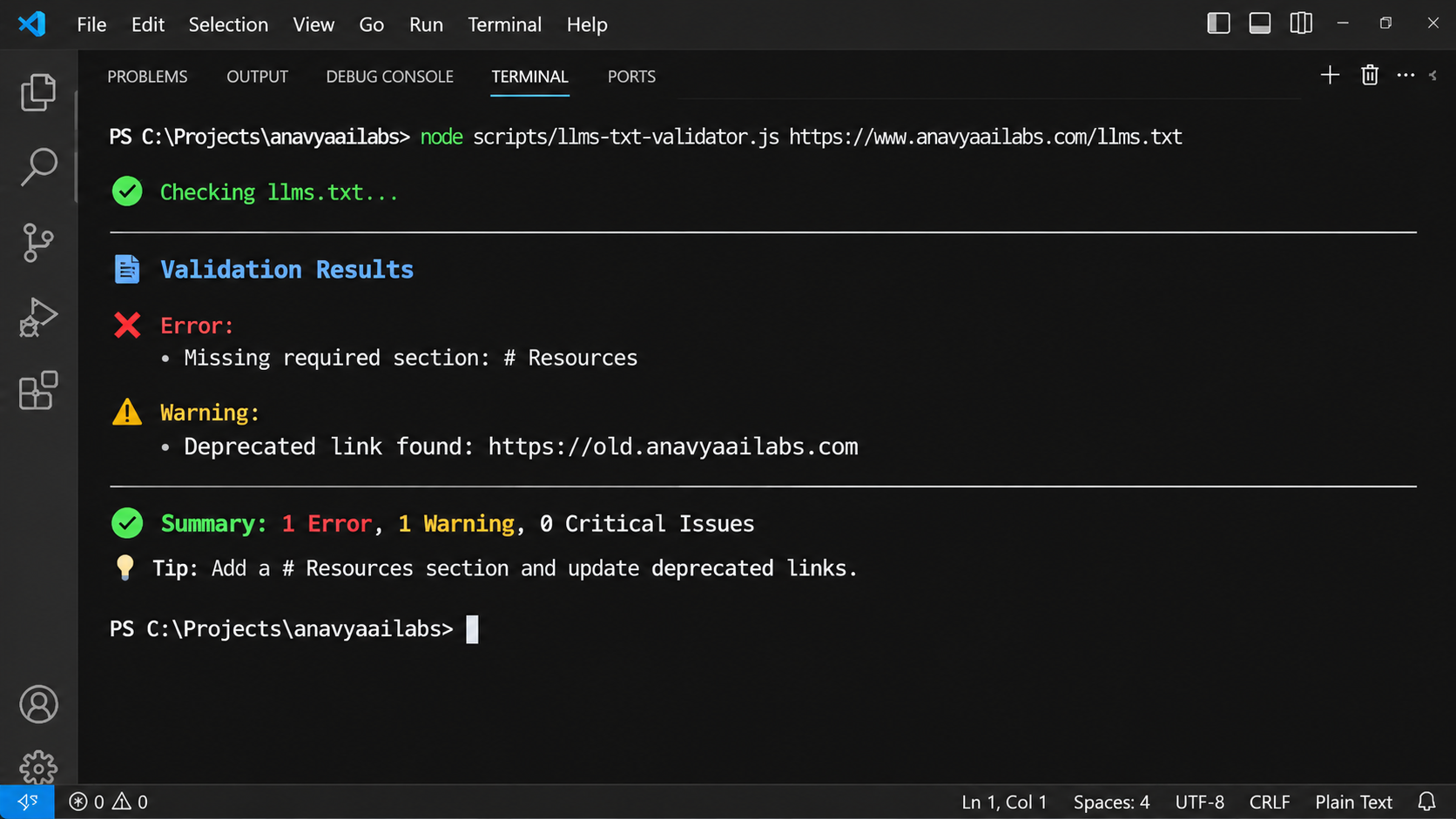
The script separates errors from warnings, so you can decide what to fix first.
How to Fix the Most Common Errors
The file does not load. Confirm the path is /llms.txt at the root of the domain, that the server serves it as text, and that no redirect or robots.txt rule blocks it. Redeploy if the file exists in your project but not on the live site.
The title is missing or incorrect. The first line must be an H1 heading with the site name. Remove any content above it, including blank lines that contain hidden characters, and confirm the heading uses a single hash mark followed by a space.
The summary is not a blockquote. Begin the summary line with an angle bracket and a space. Keep it to one or two sentences that state what the site offers and who it serves.
Link lines are malformed. Each entry should follow the pattern dash, space, title in square brackets, URL in parentheses, then an optional colon and description. Copy a correct line when you add new entries rather than typing the format from memory.
Links are broken or relative. Use absolute URLs that include the protocol and domain. Replace each 404 or 410 entry with a current page, or remove it.
Links redirect unnecessarily. Update the entry to the final address so the file points directly to the page.
Entries are duplicated. Keep the entry in the section where it belongs most clearly, and delete the duplicate.
The content is out of date. Compare the summary and descriptions with the current site, and update any entry that refers to a product, plan, or page that has changed.
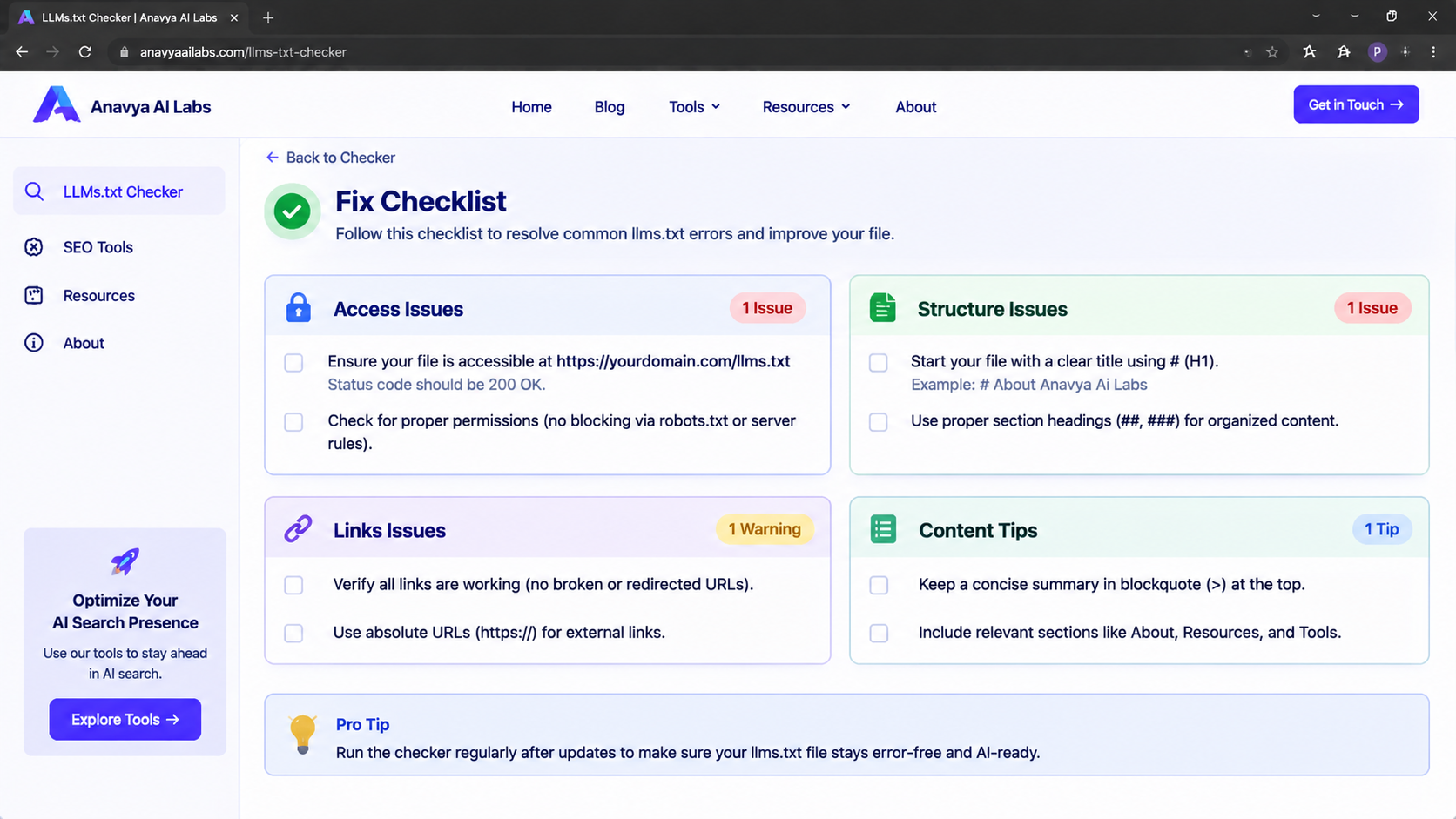
Fix errors in order of impact, then run the checker again to confirm each change.
Build a Routine Around the Checker
A checker is most valuable when it runs regularly. Set a reminder to validate the file monthly for an active site and quarterly for a stable one. Run it again after any significant change, such as a new section, a renamed product, a retired page, or a change to your domain structure.
Keep a short record of each run. Note the date, the number of errors and warnings, and what you changed. Over time, this record shows whether the file is improving and reveals recurring problems. If the same kind of error keeps appearing, the cause is probably in your publishing process rather than in a single line of the file.
Also keep expectations realistic. A valid, accurate llms.txt file is good maintenance, and it gives anyone who reads your site through an AI tool a clear map of your most important pages. However, the file alone does not guarantee that AI systems will read or cite your content. Use the checker to keep the file correct, and keep your attention on the fundamentals that determine whether your pages are accessible, clear, and credible.
Frequently Asked Questions
Is there an official llms.txt checker? There is no single official checker for the proposal. Combining availability tests, structure tests, link tests, and manual content review gives a reliable result, and the script in this article covers the parts that can be automated.
How often should I check the file? Monthly for sites that change often, quarterly for stable sites, and after every significant change to the site's structure or content.
Do warnings need to be fixed? Warnings do not always break the file, but they usually reduce its quality. Fix them when the change is simple, and decide case by case when a warning reflects a deliberate choice.
Can a checker confirm that my descriptions are accurate? No. A checker can test whether links work and whether the format is correct. Accuracy requires a person to compare each description with the page it names.
Does a valid file improve AI visibility? Not on its own. A valid file is correct and easy to read. Visibility depends on crawler access, clear page structure, credible content, and consistent information across the web.
Should I include a companion full-text file? Only if you can keep it accurate. An outdated full-text file can mislead more than a missing one, so validate it with the same care as the main file.
Conclusion
Finding errors in an llms.txt file means testing four things: whether the file loads, whether its structure follows the expected format, whether its links work, and whether its content still describes the site. A checker can automate the first three, and a person must review the fourth. Each stage catches a different kind of problem, so run all of them.
Read the report in order, fix errors before warnings, and confirm each change by running the checker again. Repeat the process on a schedule and keep a short record of the results. A file that is correct, current, and easy to read is a small but worthwhile part of maintaining a clear website.
Key Takeaways
- A complete llms.txt check covers availability, structure, links, and content, and each area catches different problems.
- Confirm the file returns a successful status, is served as text, and is not blocked by robots.txt before checking anything else.
- The file must begin with an H1 title, include a blockquote summary, group links under H2 sections, and format each link correctly.
- Read the report in order, fix errors before warnings, and verify each fix by running the checker again.
- Run checks on a schedule and review the content manually, because automated tools cannot judge accuracy.


