
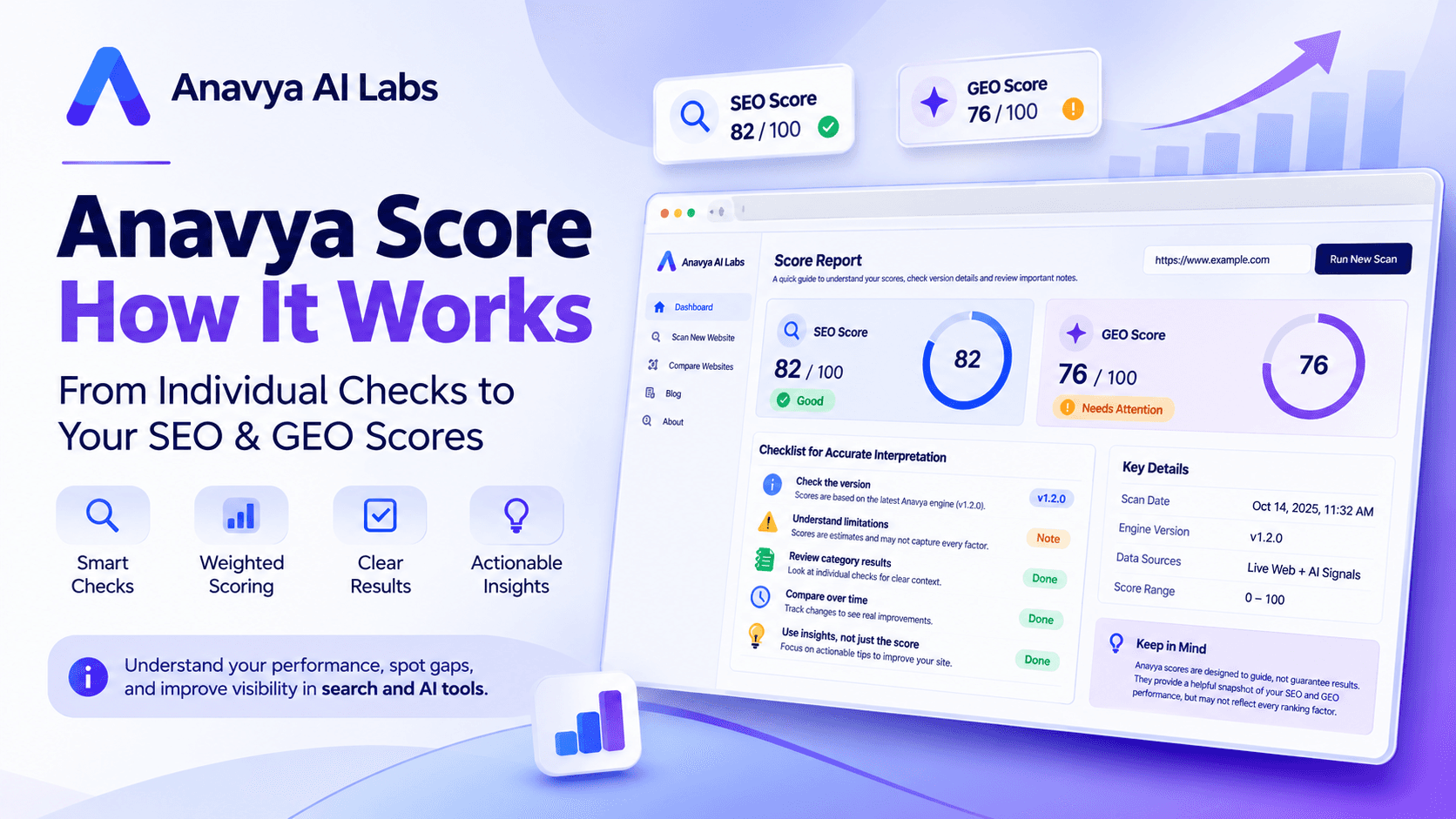
A score is only useful if you understand what it measures. A number out of 100 can tell you that a website needs attention, but it cannot tell you why, or whether a change of five points matters, unless you know how it was calculated. This article explains how the Anavya SEO and GEO scores are built, from the individual checks to the final number, so you can read a report with confidence and act on it.
The methodology has four parts: the checks that collect evidence, the way each check is converted into a result, the weights that combine results into category scores, and the rules that produce the overall score. We also explain what the score does not measure, because a responsible score is as clear about its limits as about its strengths.
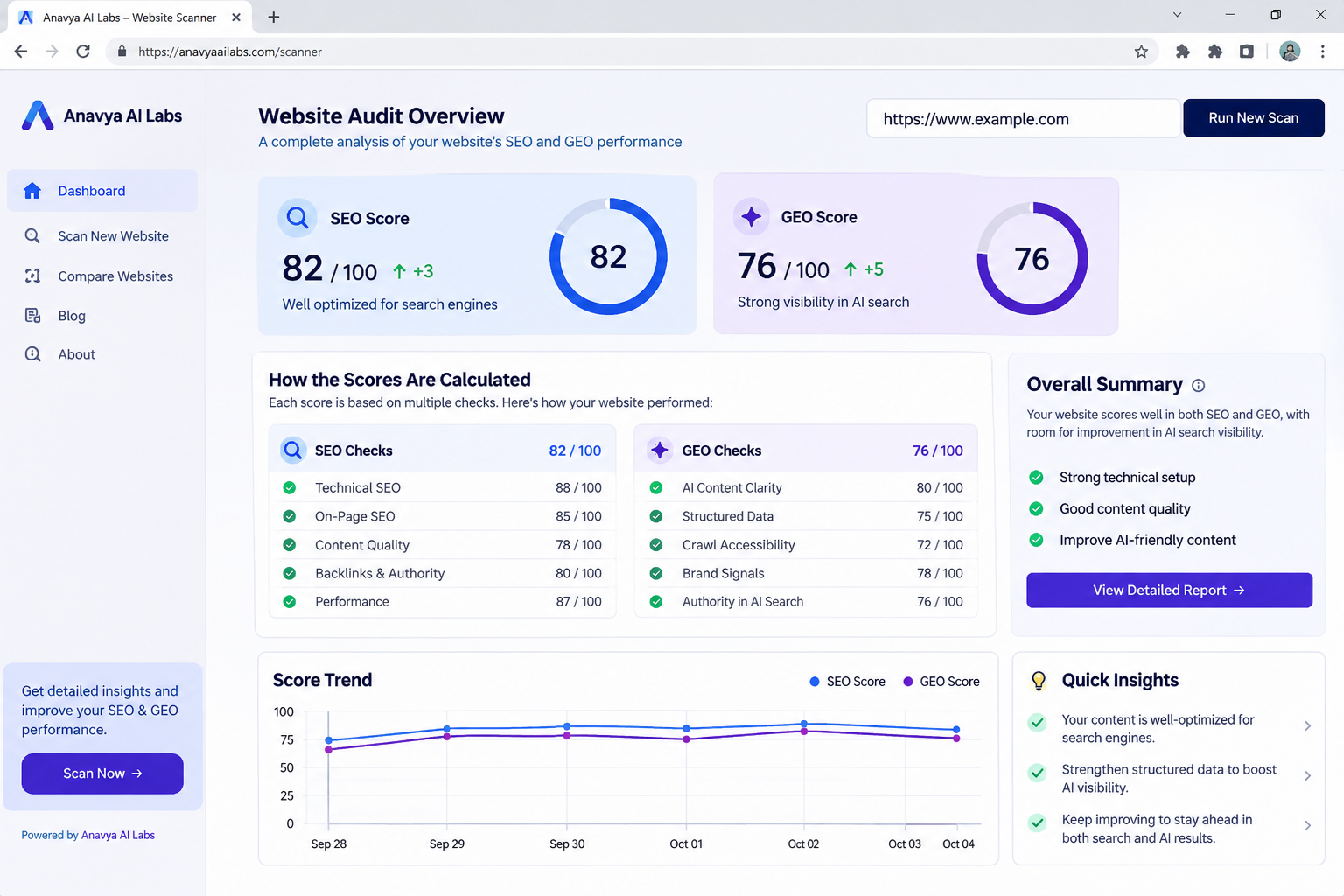
Each score starts with individual checks, which are grouped into categories and then combined into one result.
Two Scores, Two Questions
Anavya reports two related scores, and they answer different questions.
The SEO score asks how well a website can be crawled, understood, and ranked by traditional search engines. It focuses on technical health, on-page structure, content quality, performance, and authority signals.
The GEO score asks how well a website can be accessed, understood, and cited by AI-driven search and answer systems. It focuses on crawler access, entity clarity, structured data, the extractability of facts, and the credibility signals that make content suitable for citation.
The two scores share some checks, because a page that is hard to crawl is hard for both traditional search and AI systems to use. They also differ, because AI systems rely on signals that traditional rankings do not weigh in the same way. Reporting the scores separately makes it clear which problems affect which kind of visibility.
Step 1: Collect Evidence Through Checks
Each score is built from a set of checks. A check is a single, specific, observable test of a page or a site. Examples include whether a page has one H1 heading, whether a title tag is present, whether a robots.txt file blocks a named AI crawler, or whether structured data is valid.
Checks are designed to meet four standards:
- Observable: the result can be verified from the page, the server response, or a published file
- Specific: the check tests one thing, so a failure points to one fix
- Repeatable: the same site returns the same result when checked again under the same conditions
- Relevant: the check relates to how search or AI systems actually access or use content
Checks that cannot meet these standards, such as those based on a vague sense of quality, are left out of the score. They can still be reviewed manually, but they should not drive a number.
Step 2: Convert Each Check Into a Result
Raw observations are converted into one of three results for each check:
- Pass means the check meets the standard and contributes its full value.
- Warning means the check partly meets the standard, or meets it in a way that could be improved. It contributes part of its value.
- Fail means the check does not meet the standard and contributes no value.
For checks that produce a measurement, such as page load time or the share of images with alt text, the measurement is first compared with a defined threshold. For example, a page may pass a performance check when its main content loads within a set time, warn when it is slower but still usable, and fail when it exceeds a limit that is clearly harmful to users.
This approach keeps the score transparent. Anyone can look at a result and see which threshold it crossed, and the same threshold applies to every site.
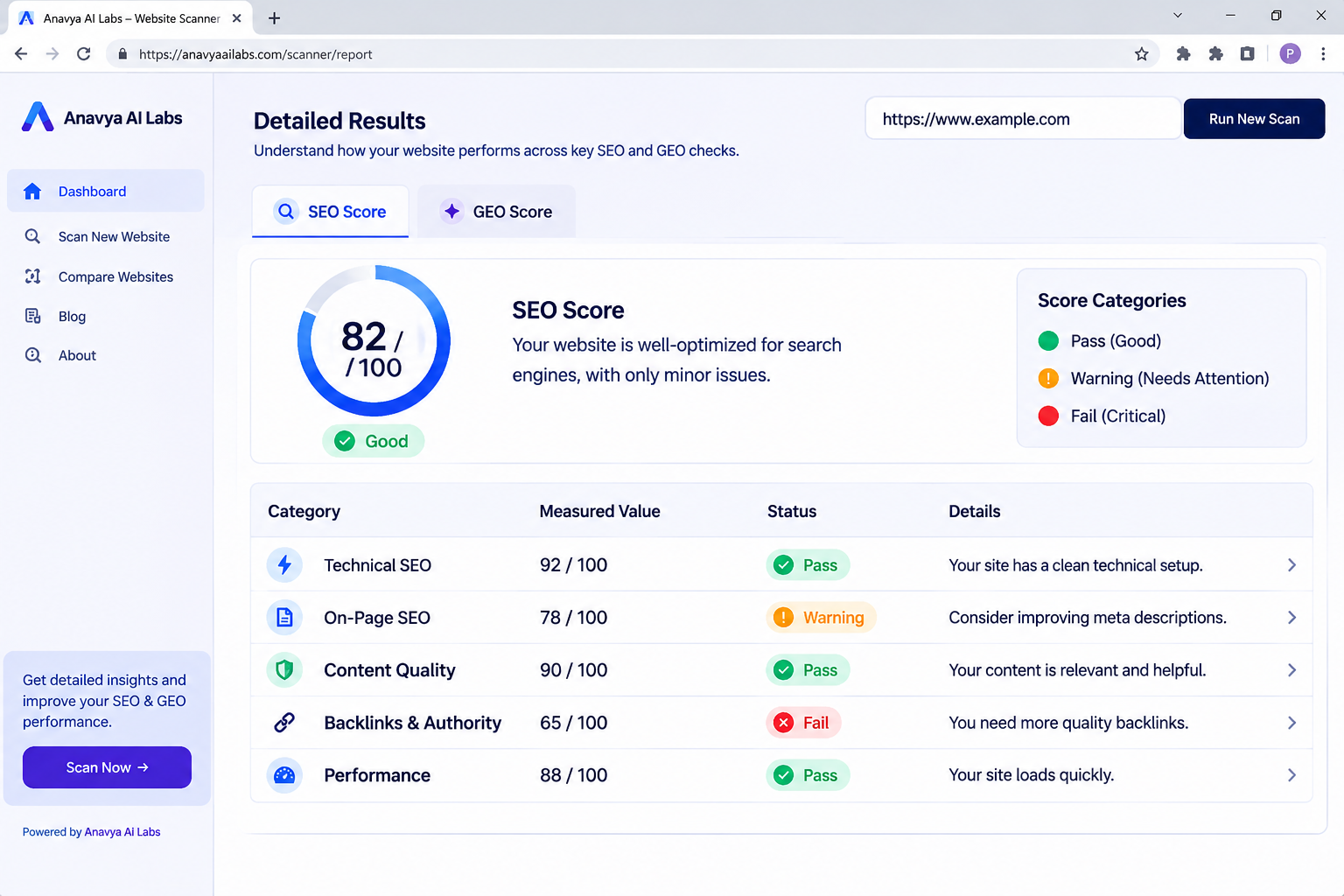
Each measurement is compared with a defined threshold and mapped to a clear result.
Step 3: Group Checks Into Categories
Checks are grouped into categories that reflect the main areas of visibility. Grouping makes it easier to see where a site is strong or weak, and it prevents one type of issue from dominating the total.
The SEO score uses these categories:
- Technical health, including crawlability, indexing signals, redirects, and errors
- On-page structure, including titles, descriptions, headings, and internal links
- Content quality and depth, including coverage of the topic and clarity of purpose
- Performance and stability, including load behavior on key templates
- Authority signals, including the quality of links that point to the site
The GEO score uses these categories:
- AI crawler access, including how robots.txt and page-level rules treat AI agents
- Entity clarity, including consistent identity, location, and offering information
- Structured data, including the presence and validity of relevant schema
- Extractable facts, including direct answers, definitions, and specific statements
- Citation credibility, including attribution, authorship, and dating of claims
Some categories appear in both scores, but they are measured with different emphasis. For example, technical health matters to both, while extractable facts matter far more to the GEO score.
Step 4: Apply Weights
Not every category carries the same importance. Each category is assigned a weight, and the weights add up to 100 for each score. A category with a higher weight has more influence on the total.
The weights below illustrate the structure of the calculation.
| SEO category | Weight | GEO category | Weight |
|---|---|---|---|
| Technical health | 25 | AI crawler access | 25 |
| On-page structure | 20 | Entity clarity | 15 |
| Content quality and depth | 20 | Structured data | 15 |
| Performance and stability | 15 | Extractable facts | 25 |
| Authority signals | 20 | Citation credibility | 20 |
Weights are set according to how strongly each category tends to affect outcomes, based on the evidence available at the time. They are not fixed forever. When the evidence changes, the weights can change too, and any change is documented in the methodology version history described later.
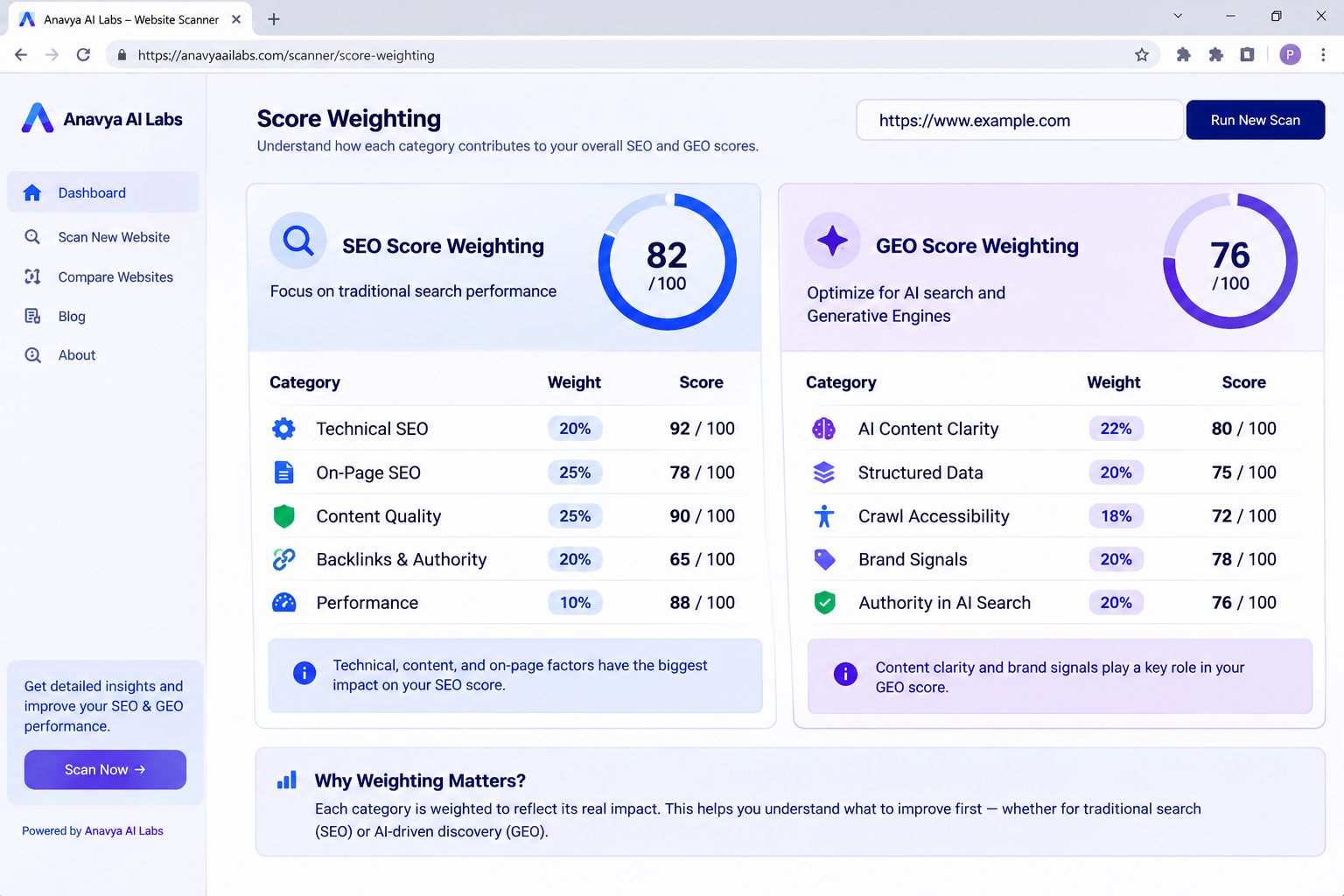
Weights determine how much each category influences the total. Both scores total 100 points.
Step 5: Calculate the Category and Overall Scores
Each category score is calculated from its checks. Pass results earn full credit, warnings earn partial credit, and failures earn none. The category score is then scaled to its weight.
Here is a simplified illustration. Suppose a category has four checks, and the site earns full credit on two, partial credit on one, and none on one. The category has earned 2.5 of 4 possible check points, or 62.5 percent of the category. If that category carries a weight of 20, it contributes 12.5 points to the total.
The overall score is the sum of all category contributions, rounded to a whole number. The SEO and GEO scores are calculated in the same way but use their own category lists and weights, so they are never added together or averaged.
Rounding happens only at the final step. This avoids cumulative errors that could make small changes appear larger or smaller than they are.
Step 6: Read the Score Correctly
A score is a summary, not a diagnosis. Reading it well means looking at three things.
The category breakdown. A total of 70 can hide very different situations. A site with 90 in technical health and 40 in extractable facts has a different problem from one with a balanced profile at 70. The category view shows where the effort should go.
The individual failures. Each failed or warning check points to a specific observation. Reading those observations tells you what to change, while the score tells you how much it matters relative to everything else.
The change over time. A single score is a snapshot. Comparing scores from the same methodology version across several scans shows whether a site is improving. A change of a few points between scans may reflect normal variation or a minor update, so look for sustained movement before drawing conclusions.
A Worked Example
Consider a small professional services firm that receives a GEO score of 58. The category breakdown shows strong AI crawler access, where the firm allows the relevant agents on its public pages. Entity clarity is moderate, because the company description differs between the homepage and an online directory. Extractable facts are weak, because most service pages open with background before stating what the firm offers.
The failures point to three practical actions. The firm should align its company description across its website and directories, rewrite the opening of each service page to state the offering and its scope in the first paragraph, and add attribution and dates to the statistics that appear on its pages.
After these changes, the next scan shows the extractable facts category rising substantially, while the entity clarity category improves more modestly. The overall GEO score moves from 58 to 71. The firm can see which changes produced which movement, because the category breakdown reflects the work it did.
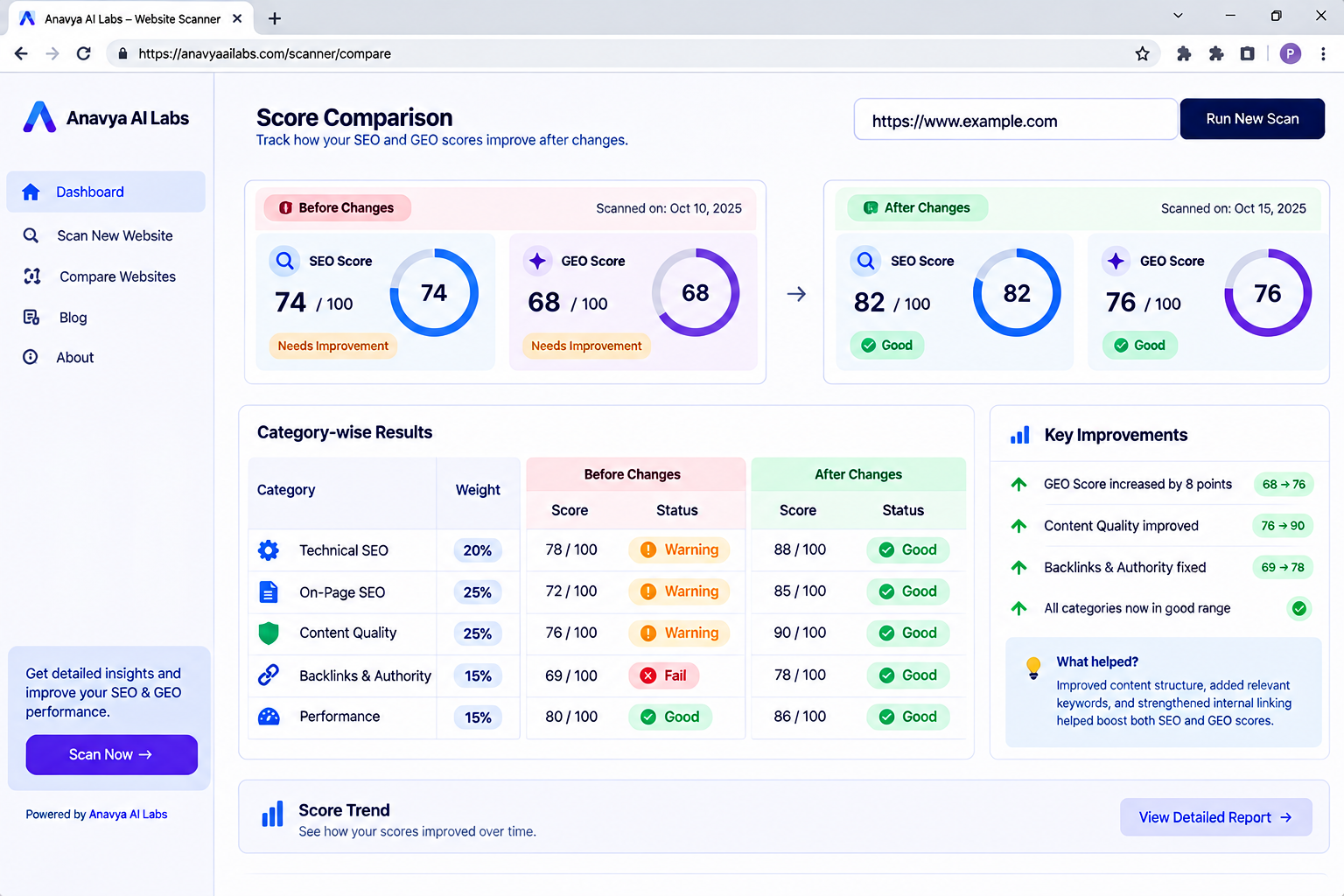
Category-level results show which changes moved the score and by how much.
What the Score Does Not Measure
A responsible methodology states its limits clearly.
The score does not measure rankings or citations directly. It measures the conditions that make a site accessible, understandable, and credible. A high score does not guarantee a ranking, and a low score does not guarantee a loss of visibility. Those outcomes depend on competitors, search demand, and many factors outside the site.
The score does not judge business quality. It cannot evaluate whether a product is good, a price is fair, or a service delivers results.
The score does not replace human judgment. Some important questions, such as whether content fully serves the audience's intent, require review by a person. The score can flag where to look, but it cannot decide on its own.
The score is limited by what can be observed. Checks rely on the content that a crawler or tool can see. Content that is hidden, blocked, or rendered only in ways a tool does not process may be scored lower than its true quality.
Versioning and Updates
Methodology changes over time, as search and AI systems change and as better evidence becomes available. To keep scores comparable, each methodology has a version number, and each score report states which version produced it.
Changes to checks, thresholds, or weights are recorded with the date and the reason. When a methodology changes, scores from the previous version should not be compared directly with scores from the new version without an explanation. Where possible, the report indicates whether a change in score reflects a change in the site or a change in the method.
This discipline matters. A rising score that reflects a new rule is not evidence of improvement, and a falling score that reflects a stricter threshold is not evidence of decline.
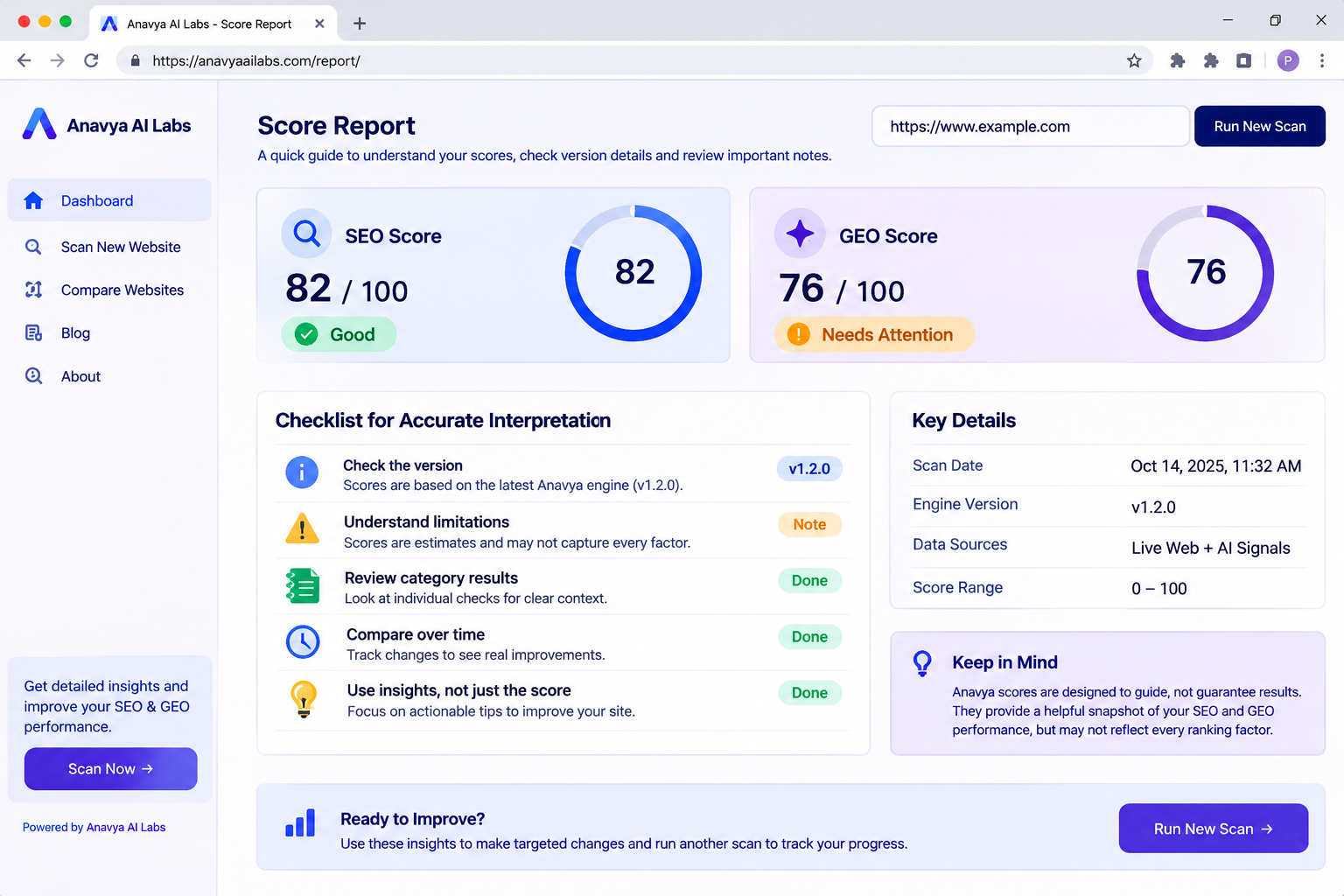
Before comparing scores, confirm the methodology version, read the category breakdown, and consider the limits of the measurement.
Frequently Asked Questions
Is the SEO score the same as a search ranking? No. The SEO score measures conditions that support search visibility. It does not predict a specific rank for any query.
Why do the SEO and GEO scores use different weights? Traditional search and AI systems rely on different signals to a different degree. Separate weights reflect those differences, and each score is calculated on its own terms.
Can a site get a perfect score? A perfect score is possible in principle, but it is not the goal. Some checks may not apply to every site, and a perfect score on the checks does not guarantee results.
What if I disagree with a check result? Review the evidence behind the result, such as the page, the server response, or the file in question. If the check misread the page, report it so the methodology can be reviewed.
Do the weights change often? They change only when the evidence supports a change, and each change is recorded in the version history.
Why does my score change even when I have not changed my site? Scores can move because the underlying content is reviewed again, because a page is updated by someone else, or because the methodology has changed. Check the version number and the category breakdown before drawing conclusions.
Conclusion
A score is useful when it is transparent. The Anavya SEO and GEO scores start with observable checks, convert each result into a clear pass, warning, or fail, group the results into categories, and combine them using published weights. Each step can be traced, and each report states the methodology version behind it.
Read the score as a guide to where to look, not as a final verdict. Use the category breakdown to set priorities, the individual results to decide what to change, and the trend over time to judge whether the changes are working.
Key Takeaways
- The SEO and GEO scores answer different questions and are calculated separately, with their own categories and weights.
- Each check produces a pass, warning, or fail result based on a defined standard or threshold.
- Category results are weighted and summed to produce each overall score, with rounding only at the final step.
- Read the category breakdown and individual results before comparing totals, and compare scores only within the same methodology version.
- A score measures conditions that support visibility. It does not guarantee rankings or citations.


